Sri Lankans vote with issues of welfare, economic reforms at stake


Sri Lankans began voting on Thursday in a snap election to decide if the Indian Ocean island will give its new leftist president greater strength to help the poor as it recovers from a financial meltdown.
Just over 17 million Sri Lankans are eligible to elect lawmakers to the 225-member parliament for a five-year term. A record 690 political parties and independent groups are in the fray across 22 electoral districts.
“I think we are seeing the first signs of a positive political change in Sri Lanka after the president was elected and we should give him the chance to continue that change,” said Umeshi Perera, 32, who queued to vote in a Colombo suburb.
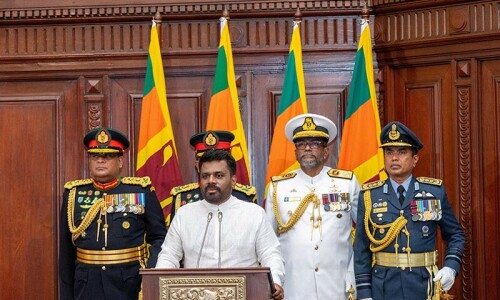
The president, Marxist-leaning Anura Kumara Dissanayake, 55, was elected in September but his National People’s Power (NPP) coalition had just three of parliament’s 225 seats, prompting him to dissolve it and seek a fresh mandate.
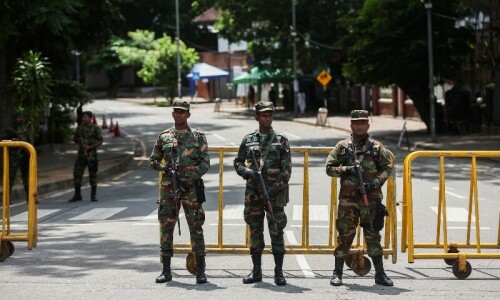
Voting was proceeding smoothly, a police spokesman said, after more than 7,000 officers fanned out to more than 13,400 polling stations nationwide to keep the polls free and fair.
“The military is also on standby to assist the police but we do not expect any incidents,” the spokesman, Nihal Thalduwa, added.
People trickled into temples, schools and other public buildings being used as polling stations soon after polls opened. Votes will be counted soon after polling closes on Thursday, with results set for Friday.
Analysts say Dissanayake’s coalition is expected to draw significant support, while a victory for a rival could lead to a policy logjam the country cannot afford.
A political outsider in a country dominated by family parties for decades, Dissanayake backs policies to fight poverty, such as bigger welfare schemes, as well as battle graft.
Sri Lanka typically backs its president in general elections, especially if they are held in quick succession.
The president wields executive power but Dissanayake still requires a parliamentary majority to appoint a fully-fledged cabinet and deliver on key election promises to cut taxes, support local businesses, and fight poverty.
“This election is critical as it is a test for the NPP to get the numbers needed for the IMF package and to take forward promised governance, constitutional and economic reforms,” said Bhavani Fonseka, a researcher at Colombo’s Centre for Policy Alternatives.
The main challenger to Dissanyake’s coalition is the Samagi Jana Balawegaya party of opposition leader Sajith Premadasa, who favours a mix of interventionist and free-market economic policies.
Also a key contender is the New Democratic Front, backed by previous President Ranil Wickremesinghe.
Economic recovery
A nation of 22m just across the southern tip of India, Sri Lanka was crushed by a 2022 economic crisis triggered by a severe shortage of foreign currency that caused its economy to shrink by 7.3 per cent in 2022 and 2.3pc last year.
Boosted by a $2.9 billion bailout programme from the International Monetary Fund (IMF), the economy has begun a tentative recovery, but the high cost of living is still a critical issue for many voters, especially the poor.
Dissanayake also aims to tweak targets set by the IMF to rein in income tax and free up funds to invest in welfare for the millions hit hardest by the crisis.
But investors worry his desire to revisit the terms of the IMF bailout could delay future disbursements, making it harder for Sri Lanka to hit a key primary surplus target of 2.3pc of GDP in 2025 set by the IMF.
“In past elections, people did not have confidence in us, but in September people gave us victory and proved that we are a winning party and we can form a government,” Dissanayake said on Sunday near the end of campaigning.
“The next task is to unite people from the four corners of this country and build a powerful people’s movement.”