Biden apologises for Native American boarding school atrocities

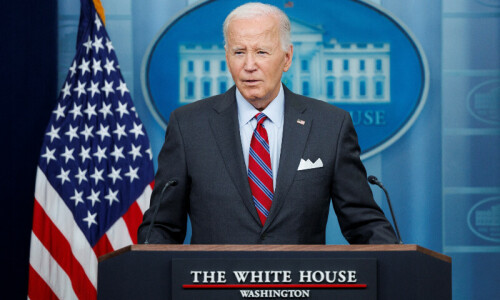
PHOENIX: US President Joe Biden delivered a historic apology on Friday for one of the country’s “most horrific chapters”: abducting Native American children from their families and placing them in government boarding schools to erase their culture.
From the early 1800s until the 1970s, the United States ran hundreds of Indian boarding schools across the country to forcibly assimilate Native children into European settler culture, including conversion to Christianity.
A recent government report revealed harrowing instances of physical, mental, and sexual abuse, along with the deaths of nearly a thousand children.
“I formally apologise, as president of the United States of America, for what we did,” he said in an impassioned speech at the Gila River Indian Community in Laveen Village, Arizona that was streamed live by the White House.
He called the roughly 150 years the school system existed one of the “most horrific chapters in American history” and a “sin on our soul.”
“I know no apology can or will make up for what was lost during the darkness of the federal boarding school policy,” he continued.
“Today, we’re finally moving forward into the light.”
Biden was joined by US Interior Secretary Deb Haaland, the first Native American to serve as a cabinet secretary, who struck a defiant tone. Federal authorities “failed to annihilate our languages, our traditions, our life ways,” she said.
Despite “everything that has happened, we are still here.”
Under Biden’s administration, there has been a significant investment in Native American communities, with executive actions expanding Tribal autonomy and designating monuments to protect sacred ancestral sites.
The apology follows formal declarations in Canada, where thousands of children died at similar boarding schools, and other countries around the world where historic abuses of Indigenous populations are increasingly being recognised.
Rare presidential apology
In all, there were more than 400 schools, often church-run, across 37 states or then-territories. Native children were forcibly taken under a policy of what activists call cultural genocide to “civilise” them, a brutal agenda summed up in the phrase “Kill the Indian, Save the Man.” Emerson Gorman, a Navajo Nation elder and healer, said in a 2020 interview that he was taken from his family at just five years old.
At the boarding school, boys were forced to cut their long braids, forbidden to speak their language, told their religion was “evil,” and pressured to convert to Catholicism.
Official apologies for the nation’s past sins are rare. In 1988, President Ronald Reagan signed legislation to compensate over 100,000 Japanese Americans incarcerated in internment camps during World War II.
President Bill Clinton in 1997 formally apologised for the infamous mid-20th-century medical experiment in which hundreds of Black men were intentionally left untreated for syphilis. And in 2016, Barack Obama became the first sitting president to visit Hiroshima, although he stopped short of a formal apology.
In 2008, the US House of Representatives apologised for 246 years of African American slavery and the oppressive Jim Crow laws. The Senate passed a similar resolution the next year. But the Congressional apologies did not offer compensation to the descendants of slaves.
Published in Dawn, October 26th, 2024