0
0


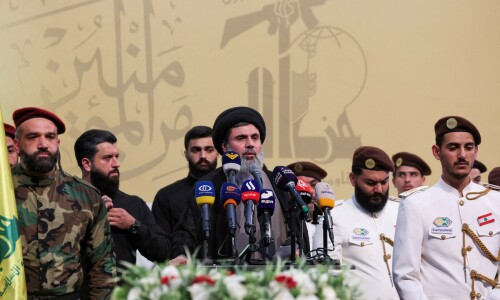
BEIRUT: Hezbollah left the door open on Tuesday to a negotiated ceasefire with Israel though also making it clear that their capabilities were ‘intact’ after Israeli forces made new incursions in the south of Lebanon.
In a televised speech, Hezbollah’s deputy leader Naim Qassem said he supported attempts to secure a truce, and for the first time did not mention a ceasefire in Gaza as a precondition to halting combat on the Lebanon-Israel border.
Qassem said Hezbollah supported attempts by Speaker of Parliament Nabih Berri, a Hezbollah ally, to secure a halt to fighting, which has escalated in recent weeks with the Israeli ground incursions and the killing of top Hezbollah leaders.
“We support the political activity being led by Berri under the title of a ceasefire,” Qassem said in his 30-minute televised address.
It was not clear whether this signalled any change in stance, after a year in which the group has said it is fighting in support of Palestinians in Gaza, and would not stop without a ceasefire there.
UN officials warn Beirut may face same ‘spiral of doom’ as Gaza, seek urgent action to stop war
Qassem said the conflict with Israel was a “war about who cries first”, and Hezbollah would not cry first. The group’s capabilities were intact despite “painful blows” from Israel.
“We are striking them. We are hurting them and we will prolong the time. Dozens of cities are within range of the resistance’s missiles. We assure you that our capabilities are fine,” he said.
He said Israel had yet to advance after ground clashes that broke out in south Lebanon a week ago.
“In any case, after the issue of a ceasefire takes shape, and once diplomacy can achieve it, all of the other details can be discussed and decisions can be taken,” Qassem said.
“If the enemy (Israel) continues its war, then the battlefield will decide.”
Meanwhile, Iran’s Foreign Minister Abbas Araqchi will visit Saudi Arabia and other countries in the Middle East this week “to discuss ways to prevent the shameless crimes of the Zionist regime in Lebanon in continuation of the crimes in Gaza”.
Sources say that Gulf Arab states have sought to reassure Tehran of their neutrality in the conflict, though the FM had already made it clear any attack on Iran’s infrastructure would be met with retaliation.
On the ground, the area of Israeli operations in Lebanon has been expanding.
The Israeli military said it was conducting “limited, localised, targeted operations” in Lebanon’s southwest, having previously announced such operations in the southeast.
UN seeks urgent action
Also, UN officials called on Tuesday for urgent action to stop the escalating conflict in Lebanon from spiralling into a similar scene of devastation as seen in Gaza.
“We need to do everything we can to stop that from happening,” said Matthew Hollingworth, director for the United Nations World Food Programme in Lebanon.
Speaking from Beirut, he told a press briefing in Geneva that he spent the first half of the year coordinating WFP’s operations in Gaza before taking the helm of its Lebanon office, and was deeply concerned by the similarities.
“It is in my mind from the time I wake until the time I sleep, that we could go into the same sort of spiral of doom… We shouldn’t allow that to happen,” he said.
Hollingworth said many people were fleeing because they “have watched over the last year as the war in Gaza has continued and neighbourhoods have been decimated and pounded, and that is deep in their gut, in their hearts, in their minds”.
James Elder, spokesman for the UN children’s agency Unicef, warned that “the commonalities are unfortunately absolutely there to be seen, whether it is displacement on the ground, impact upon children or language being used to soften the realities on the ground”.
“We are seeing the same patterns that we saw in Gaza,” added Jeremy Laurence of the UN rights office.
“The devastation is beyond belief for all people in Lebanon as it is in Gaza. We can’t let this happen again.”
Published in Dawn, October 9th, 2024