World powers warn of Israeli attack’s repercussions


• China, Russia, France seek immediate, comprehensive ceasefire
• Biden says US fully backs Israel’s right to self-defence
• Muslim states condemn assassination
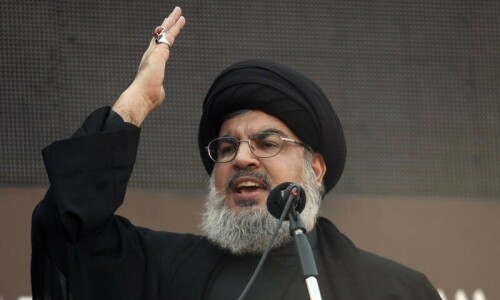
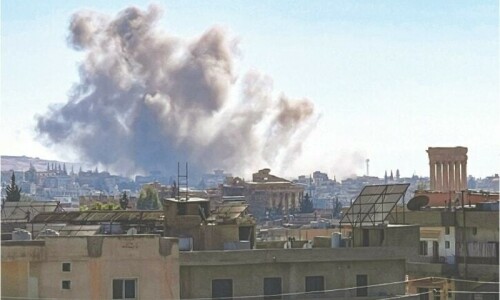
BEIRUT: With the spectre of all-out war looming over the Middle East, world powers warned of the potential repercussions of Hezbollah leader Sayyed Hassan Nasrallah’s assassination by Israel amid growing calls for an immediate and permanent ceasefire in the Middle East.
Chinese Foreign Minister Wang Yi told the UN General Assembly on Saturday that there must not be a delay in reaching a “comprehensive ceasefire” in the Middle East, and said a two-state solution between Israelis and Palestinians remains the way out of the region’s tensions.
Russia strongly condemned “yet another political assassination” in the Lebanese capital Beirut. Its foreign ministry said, “This forceful action is fraught with even greater dramatic consequences for Lebanon and the entire Middle East. The Israeli side could not fail to recognise this danger, but took the step of killing Lebanese citizens, which would almost inevitably provoke a new outburst of violence. Thus, it bears full responsibility for the subsequent escalation.”
However, US President Joe Biden the United States fully supported Israel’s right to defend itself and said he had directed Defence Secretary Lloyd Austin to further enhance the US military forces in the Middle East, calling Hassan Nasrallah’s killing “a measure of justice” for his many victims.
Israel’s chief of the general staff Herzi Halevi said Hassan Nasrallah “indiscriminately murdered Israeli civilians” and aimed “to end this war” with the destruction of Israel.
France, Germany
On the other hand, France called on Israel to stop striking Lebanon. Accompanied with Lebanese Prime Minister Najib Mikati, French Foreign Minister Jean-Noel Barrot said Paris wanted “an immediate halt to Israeli strikes in Lebanon” and was “opposed to any ground operation”, the foreign ministry said.
Also, German foreign minister Annalena Baerbock warned of ‘spiral of violence’ in Middle East, terming the situation ‘extremely dangerous’. “There is a threat that this entire region will slip further into an absolute spiral of violence.”
Turkish president Tayyip Erdogan, in a post on X, condemned the attacks as part of an Israeli policy of “genocide, occupation, and invasion” and said the Muslim world should show a more “determined” stance.
In another post on X, Iran’s foreign ministry spokesman Nasser Kanani wrote, “The glorious path of the leader of the resistance, Hassan Nasrallah, will continue and his sacred goal will be realised in the liberation of Quds (Jerusalem), God willing.”
Iraq’s premier Mohammed Shia Al-Sudani said the killing showed “the reckless desire to expand the conflict at the expense of all the peoples of the region and their security and stability”.
Also, the foreign ministry of Syria condemned the attack, stating “The Zionist entity (Israel) confirms through this despicable aggression, once again… its barbarism and wanton disregard for all international standards and laws.”
Palestinian president Mahmoud Abbas offered his condolences to the Lebanese government and people of Lebanon over the civilian casualties in the ongoing Israeli aggression.
Also, the Hamas in Gaza and Houthis in Yemen condemned the unabated Israeli aggression in the region. “We condemn in the strongest terms this barbaric Zionist aggression and targeting of residential buildings… and we consider it a cowardly terrorist act,” Hamas said.
Published in Dawn, September 29th, 2024