Fear grips minorities after deadly violence in Bangladesh


 0
0


DHAKA: Ethnic minorities in Bangladesh’s southern hilly region are living in fear after clashes in which four people were killed and several wounded, police and witnesses said on Saturday.
Sectarian violence, sparked by the lynching of a Bengali man on Wednesday, has displaced scores of ethnic families after homes and businesses were set on fire in Chittagong Hill Tracts (CHT) bordering Myanmar and northeast India, they said.
A 72-hour road and waterways blockade, called by student-led ethnic groups, is underway in three hilly districts of Khagrachhari, Rangamati and Bandarban in the CHT, home to several indigenous tribal groups. The protesters are calling for punishment of those responsible for the unrest, which escalated on Thursday, leading to the deaths of at least four men from ethnic minorities. Many families in Khagrachhari and Rangamati have fled, leaving behind burning houses and businesses.
The Bangladesh Hindu Buddha Christian Oikya Parishad (HBCOP), the largest organisation of minorities, has called on the United Nations to investigate communal violence against minority groups. “Secretary General of the United Nations Antonio Guterres has been called upon to organise a fair and partial investigation into the incidents of communal atrocities against minorities,” Monindro Kumar Nath, acting general secretary of the Bangladesh HBCOP, told ANI.
Hindu, Buddhist and Christian groups urge UN to investigate communal violence
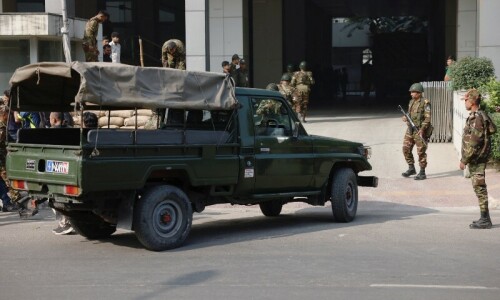
Despite heavy army, police and Border Guard Bangladesh patrols, residents remain on edge. “A tense situation is prevailing […] Police and security forces are jointly patrolling, hopefully, peace will be restored soon,” said Ahsan Habib, deputy inspector general of Chittagong police.
The Bengali man’s lynching triggered retaliatory attacks on ethnic minority communities, officials said. Dozens of houses and businesses, primarily belonging to Buddhist minorities, were set on fire or attacked. Buddhist temples became targets, and loudspeakers in local mosques were used to incite Bengali mobs, witnesses said. In response, local authorities have imposed Section 144, a curfew-like measure, in Khagrachhari and Rangamati.
The interim government led by Nobel Peace Prize laureate Mohammad Yunus, which took power after deadly protests that led to the ousting of Prime Minister Sheikh Hasina last month, has expressed deep regret over the violence. It has told all security forces to exercise maximum restraint and prioritise the safety of all residents. A high-level committee will be formed to investigate the violence, Home Affairs Adviser Lt Gen (retd) Jahangir Alam Chowdhury said after a meeting with local political leaders and various organisations.
In the 1980s, the government resettled thousands of landless Bengali families in the 5,500 sq miles CHT, fuelling tension between the new settlers and indigenous groups.
In 1997, the then government of Prime Minister Sheikh Hasina signed a peace accord with the Shanti Bahini, a tribal guerrilla group, ending a 25-year insurgency that sought political autonomy for the region. In 1997, the then government of Prime Minister Sheikh Hasina signed a peace accord with the Shanti Bahini, a tribal guerilla group, ending a 25-year insurgency that sought political autonomy for the region.
Published in Dawn, September 22nd, 2024