India-held Kashmir votes for first time after 2019 scrapping of special status



India-held Kashmir began voting on Wednesday in the first local elections since the cancellation of its special semi-autonomous status in sparked fury in the valley.
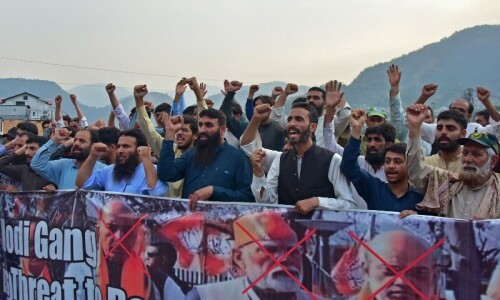
Many in the Muslim-majority territory of 8.7 million registered voters remain bitter over the 2019 order by the Hindu-nationalist government of Indian Prime Minister Narendra Modi to impose control from New Delhi.
A federally appointed governor has controlled the territory since, with the first regional assembly election in a decade viewed by many as being more about exercising their democratic rights than practical policies.
Voters queued under heavy security in the three-phased elections, which will be staggered geographically due to security arrangements and logistical challenges in the mountainous region.
“After 10 years we are allowed to be heard,” said Navid Para, 31, among the first to vote in the cool morning mountain air of Pulwama, near the main city of Srinagar.
“I want my voice represented”, he added.
About 500,000 Indian troops are deployed in the region, battling a 35-year uprising in which tens of thousands of civilians, fighters and soldiers have been killed, including dozens this year.
Modi urged people to vote in “large numbers and strengthen the festival of democracy”.
‘Solve our problems’
“Our problems have piled up,” said retired government officer Mukhtar Ahmad Tantray, 65, in Srinagar.
“The reins (of power)… were handed over to the bureaucracy,” he added.
Turnout is expected to be high, unlike in past elections when separatists opposing Indian rule boycotted polls, demanding the independence of Kashmir or its merger with Pakistan.
“All the politics revolves around the dispute,” said trader Navin Kotwal, 73, from Doda in Jammu district.
“All I care about is that we want to be governed by educated representatives who can solve our problems.” Farmer Ahmadullah Bhat, 47, said he had voted “to have our own government”, saying he was worried common land was being taken under the rule of federal authorities.
“I can now go to my elected representative to solve our issues”, he said.
Vigorous election campaigns have featured unusually open debates but key decisions will remain in New Delhi’s hands, including security and appointing Kashmir’s governor.
New Delhi will also have the power to override legislation passed by the 90-seat assembly.
The last round of voting will be held on October 2. Results are expected six days later.
‘Better than nothing’
Some of the worst violence this year has been in Jammu, where Modi campaigned for votes on Saturday, vowing that “terrorism is on its last legs” in a reference to armed Kashmiris fighting Indian rule.
Modi and his Bharatiya Janata Party (BJP) claim that the changes to the territory’s governance have brought a new era of peace to held-Kashmir and rapid economic growth.
The implementation of those changes in 2019 was accompanied by mass arrests and a months-long internet and communications blackout.
While this is the first ballot for the local assembly since 2014, voters took part in national elections in June when Modi won a third term in power.
Farmer Syed Ali Choudhary, 38, from Jammu district, acknowledged the assembly’s powers will “be much less” than before.
But, he said, “Something is better than nothing.”
Economic woes
Many Kashmiris are resentful of the restrictions on civil liberties imposed after 2019, and the BJP is only fielding candidates in a minority of seats concentrated in Hindu-majority areas.
Critics accused the BJP of encouraging a surge of independent candidates in Muslim-majority areas to split the vote.
A lack of jobs is a key issue. The area has an unemployment rate of 18.3 percent, more than double the national average, according to government figures in July.
Critics said that the central government has awarded major contracts, such as construction and mineral extraction, to firms outside the territory.
“My biggest concern is unemployment,” said Madiha, 27, a jobless graduate who gave only one name.
She added, “The cost of living has reached the sky. “