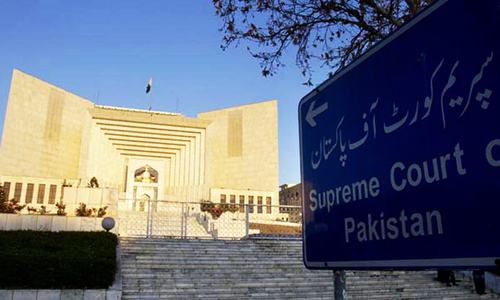
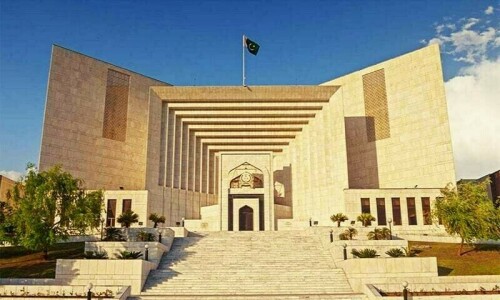
ISLAMABAD: The Supreme Court on Monday observed that, as fact-finding forums of exclusive jurisdiction, service tribunals were duty-bound to do complete and substantial justice between parties with a rational denouement of cases.
Under Article 212 of the Constitution, the service tribunal, for the purposes of deciding appeals, is deemed to be a civil court and has the same powers as vested in such a court, observed Justice Muhammad Ali Mazhar in a judgement he wrote.
“The wisdom of setting up the service tribunals under Article 212 of the Constitution is to deal with and decide matters relating to the terms and conditions of service of the civil servants,” Justice Mazhar observed, adding that all judicial, quasi-judicial and administrative authorities should carry out their powers with a judicious and even-handed approach to ensure justice according to tenor of law and without any violation of the principle of natural justice.
Headed by Justice Mazhar, a two-judge SC bench had taken up an appeal challenging the March 3, 2021 decisions of the Sindh Service Tribunal, Karachi, against two senior police officials.
Orders restoration of two police officials to their positions with back benefits
The Sindh Service Tribunal had on March 3, 2021 ordered the dismissal from service of Ghulam Murtaza Sheikh, a former senior superintendent. However, the tribunal enhanced the penalty awarded to him from three years to five years, for reduction to a lower post from BS-19 to BS-18. The tribunal also dismissed Faheem Anwar Memon, the deputy superintendent of jail, and further converted his original penalty of compulsory retirement into dismissal from service.
The Supreme Court, however, allowed the appeals and set aside the tribunal’s decisions with a directive to restore both officials to their positions with back benefits.
Not affording the right of cross-examination in the inquiry, Justice Mazhar observed, was a serious defect and in no way can be construed as taking refuge in procedural lapses. It is a grave blunder, which in fact destroyed the entire substratum of inquiry and the case of misconduct made out by the department against the petitioners.
The court also ordered sending the copy of the judgement to Sindh chief secretary, law and parliamentary affairs secretary, Criminal Prosecution Department and advocate general for drawing their attention to compile a “handbook” of inquiry procedure with excerpts of all relevant provisions of Sindh Civil Servants Act, 1973, Sindh Civil Servants (Efficiency & Discipline) Rules, 1973, Sindh Police (Efficiency and Discipline Rules), 1988, and Sindh (Repeal of the Police Order, 2002 and Revival of the Police Act, 1861) Act, 2011, including the rule of natural justice and due process of law enshrined under Article 10-A of the Constitution.
“Once the handbook is compiled and printed, a copy of handbook should be circulated at the governmental level in all government departments/attached departments for assistance and strict adherence of inquiry officers or inquiry committees so that they may be well-conversant with the precise procedure before embarking on the task of an inquiry and conduct the inquiry proceedings fair and square without any defects and ambiguities,” the judgement said.
It added: “The role of inquiry officer is to sift grain from the chaff and actually get the drift that the petitioners violated their assigned duties which could only be proved through evidence and if the opportunity of cross-examination was afforded to the petitioners as their defence to disprove the allegations raised against them. “The inquiry officer in the present case did not adhere to the principle of natural justice and due process of law. Neither the inquiry report depicts that the statements of the alleged 20 witnesses were recorded in the presence of petitioners nor any right of cross-examination was provided to the petitioners.”
Published in Dawn, September 3rd, 2024