The local administration has barred the Quetta Press Club from hosting events by organisations or political parties without a non-objection certificate (NOC), it emerged on Wednesday.
A notification from the office of the Quetta deputy commissioner, dated Tuesday, to the press club’s president said: “Owing to current law and order situation, no any organisation/political party is allowed to organise any conference/seminar in Quetta Press Club without prior approval/permission of district administration.
“Therefore, you are hereby directed not to allow any organisation/political party to organise conference/seminar without NOC/permission district administration.”
Dawn.com contacted the deputy commissioner’s office for a response but received none.
Meanwhile, a meeting of the press club’s executive body was called for Thursday to deliberate on the deputy commissioner’s notification and chart out the future plan of action.
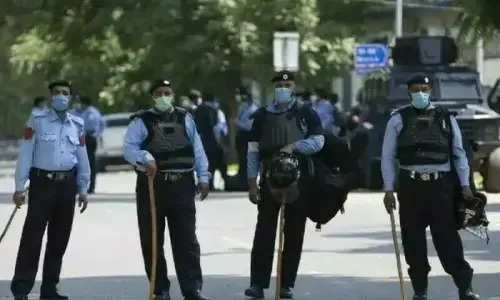
The restriction comes amid a tense security situation after dozens of militants affiliated with the banned Balochistan Liberation Army (BLA) — a separatist outfit — launched numerous attacks on Sunday midnight across Balochistan, targeting security personnel as well as civilians, particularly those hailing from Punjab.
At least 50 people, including 14 security men, lost their lives as militants went on a rampage across the province, storming police stations, blowing up railway tracks, and setting fire to almost three dozen vehicles.
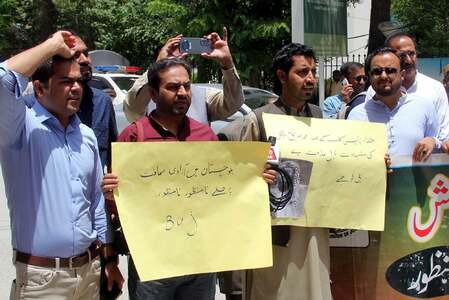
In May, the police and local administration locked the press club’s gates to stop the members of rights group Baloch Yakjehti Committee from holding a seminar.
The Balochistan Union of Journalists (BUJ) and press club had decided to launch a country-wide protest campaign against the locking up by the district administration and police.
Condemnations from press bodies
The Pakistan Federal Union of Journalists (PFUJ) condemned the Quetta administration for the restrictions.
A statement issued by the body said it took “serious exception” to the direction issued by the Quetta district administration to the press club president.
PFUJ President Afzal Butt and Secretary General Arshad Ansari condemned the actions, saying, “This is an attempt to curb free speech and press freedom in the country, and it is rejected and will not be accepted.”
They called for the urgent withdrawal of the written direction and asked the administration to desist from such “ruthless practices.” They stressed that press freedom and the right to express oneself were guaranteed in the Constitution and would be safeguarded at all costs.
“The PFUJ leadership noted that the law and order situation has not been created due to speeches and freedom of expression, but rather is a result of denial of rights, injustices in society and authoritarian behaviours of the establishment and crippled state machinery.
“They called for respect for premises like press clubs, which are meant for upholding and promoting freedom of the press and expression in the country,” the statement said.
BUJ General Secretary Abdul Shakoor condemned the move and termed it an attack on press freedom.
He said the Quetta Press Club played the role of a bridge between the people and the government. “There are political and cultural activities through which people make their voices heard in relevant forums,” Shakoor said.
Calling for such measures to be reviewed, he said the BUJ and Quetta Press Club had fulfilled their responsibilities in the past as well even before the current situation.
The Karachi Press Club (KPC) also condemned the directive in a statement.
“This unprecedented move is a blatant attack on the fundamental principles of freedom of press and freedom of speech,” said KPC President Saeed Sarbazi.
“Press clubs have historically served as vital platforms for public discourse, and imposing such restrictions undermines their very purpose.”
The KPC said the directive had “sparked widespread concern” among journalists and civil society activists with them arguing that it was a “direct attempt to stifle dissent and control the narrative”.
The statement said KPC General Secretary Shoaib Ahmed echoed Sarbazi’s concerns.
“Any interference in the affairs of press clubs is a dangerous precedent,” he said. “Freedom of expression is a cornerstone of a healthy democracy, and it must be protected from such arbitrary restrictions.”
The statement further noted that the move came at a time when tensions between the government and opposition parties have been escalating.
“Some fear that the directive is aimed at silencing critical voices and consolidating government control.
“The KPC has called on the authorities to reconsider the directive and respect the autonomy of press clubs. They argue that freedom of the press is essential for a vibrant and informed citizenry.”