KABUL: The UN mission in Afghanistan said on Sunday it was “concerned” about a morality law recently ratified by the Taliban authorities, criticising in particular restrictions on women.
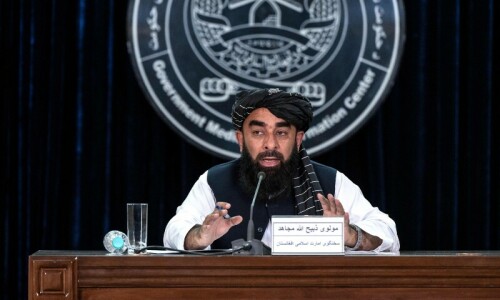
The Taliban authorities on Aug 21 announced the codification of a law with 35 articles detailing wide-ranging behaviour and lifestyle restrictions based on their strict interpretation of Islamic law.
The law sets out graduated punishments for non-compliance — from verbal warnings to threats, fines and detentions of varying lengths — enforced by the morality police under the Ministry for the Propagation of Virtue and the Prevention of Vice.
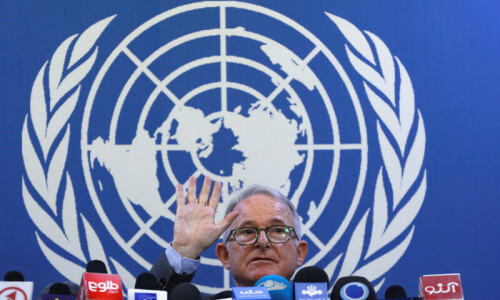
“It is a distressing vision for Afghanistan’s future, where moral inspectors have discretionary powers to threaten and detain anyone based on broad and sometimes vague lists of infractions,” said Roza Otunbayeva, head of the UN Assistance Mission in Afghanistan (UNAMA).
Discretionary powers to detain anyone based on broad, sometimes vague lists of infractions, worry UN mission
“After decades of war and in the midst of a terrible humanitarian crisis, the Afghan people deserve much better than being threatened or jailed if they happen to be late for prayers, glance at a member of the opposite sex who is not a family member, or possess a photo of a loved one,” Otunbayeva said.
Many components of the law have already been informally in place since the Taliban returned to power in August 2021, and it remained unclear if their formal codification would lead to stricter enforcement.
Women have borne the brunt of restrictions the UN has labelled “gender apartheid”, which have pushed them from public life, including barring them from secondary and higher education.
A doctor working in Kabul requesting anonymity said she felt “hopeless” hearing about the law. “It would have been better if they had announced the opening of schools and universities instead of this law. That would have given us some hope.”
The head of UN mission said the law “extends the already intolerable restrictions on the rights of Afghan women and girls, with even the sound of a female voice outside the home apparently deemed a moral violation”.
Published in Dawn, August 26th, 2024