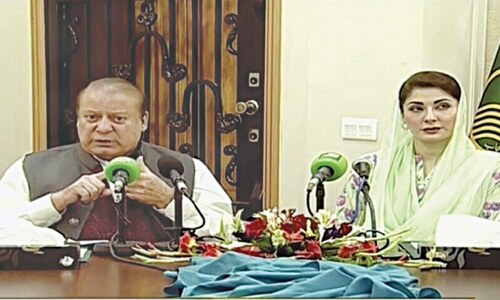
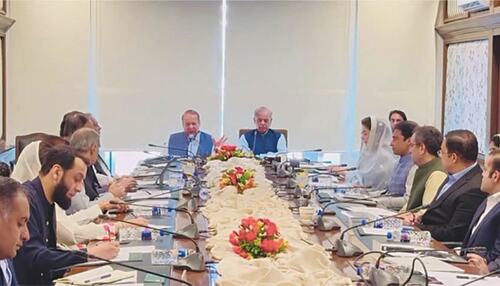
LAHORE: As the PML-N claims that the Rs14 per unit relief will lead to a 38 per cent cut in electricity bills of consumers in Punjab, economists term the measure a political optic and question its sustainability. A senior Punjab government official claims that out of 6.5 million subscribers of Lahore Electric Supply Company (Lesco), around 4.8m consume less than 500 units per month, and they will see a 38pc reduction in their power bills for August and September because of the relief announced by the Punjab government on Friday.
Similarly, subscribers of Gujranwala, Faisalabad and Multan electricity supply companies (namely Gepco, Fesco and Mepco) will also benefit from the scheme, the official said, requesting not to be named.
However, economists Khalid Mahmood Rasool and Zahid Iqbal term the measure an unsustainable game of optics.
“Unfortunately, it is only a case of political manoeuvring, ad hoc-ism and narrative management at the cost of exchequer but not a long-term solution,” says Mr Rasool.
Urge govt to curtail its expenditure instead of squeezing development funds
Holding successive governments responsible for the rising energy costs, he said that the energy agreements signed, particularly after 2013, are pinching the most because they have a huge share in the capacity payment problem.
He argued that it would have been more reasonable if the rulers had controlled their non-development expenditure and diverted that amount to such political gimmicks instead of cutting development projects to finance the relief.
He wondered what would happen after two months, recalling previous short-term measures like Ramazan Bazaars and free atta (wheat flour) schemes that failed to bring any sustainable change in the lives of the masses.
The government official said that the government’s solar scheme will become operational in two months. Under the scheme, free solar energy systems would be provided to those who consume up to 200 units. The official adds that those who consume up to 500 units would get solar panels at 10 per cent cost only.
Mr Iqbal, an academic, declared it a politically good decision but with a short-term impact that will provide immediate relief to the lower classes and help reduce inflation as the power bill significantly affects it.
The poor may be happy if they get three or four necessities of life at a reasonable rate, but who will be responsible for the negative impact on the sector whose development funds will be diverted to this electricity relief scheme, he asked.
Published in Dawn, August 18th, 2024