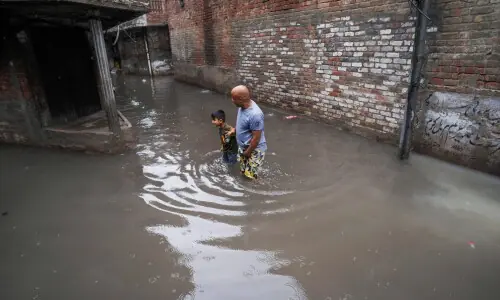
KARACHI: Urban planners and climate change experts have said that Karachi has become an “unliveable” city due to pollution, crumbling infrastructure, poor sanitation and waste management system and is increasingly becoming vulnerable to climate change owing to the faulty policies of the provincial government and city administration.
Speaking at a seminar — Saving Karachi from the Looming Perils of Climate Change — organised by the Karachi Citizens’ Forum (KCF) at the Pakistan Medical Association (PMA) House on Saturday, they also said that the most affected by these issues are the lower and lower-middle class of the city who are also “suffering badly” from problems like loadshedding and scarcity of water among others issues.
Addressing the audience, KCF convener Nargis Rahman said Karachi is among the top cities affected by climate change. “It is a neglected city that no one owns,” she said.
She added it has become a concrete jungle with a collapsing infrastructure, poor sanitation and waste management system along with serious threats to its ecosystem. The government has been given various recommendations to solve these issues but none has been implemented, she said.
Expert urges rehabilitation of Malir, Lyari rivers, lagoons and creating 2,000 mini urban forests to mitigate climate change
Climate activist and founder of the Clifton Urban Forest Masood Lohar said Karachi has become an “unliveable” city that is grappling with numerous issues. People are forced to use standby gas cylinders and electricity generators, and are getting water from tanker mafia because those utilities are in shortage or not available, he said.
However, he said the upper class are still managing things but it is the lower and lower-middle class of the city that is suffering the most due to those problems.
Talking about the worsening ecosystem of the city, Mr Lohar said rivers were destroyed and creeks were closed to reclaim land for establishing golf courses there.
He said that people wrongly believed that Karachi was not vulnerable to earthquakes. He claimed that there are “high chances” of an earthquake in the city and that too in the monsoon.
Speaking of solution, Mr Lohar said there is a need to restore Malir and Lyari rivers as well as the lagoons, harvesting rainwater, building 2,000 mini urban forests and vertical forestry and declare Turtle beach a sanctuary.
Urban planner Muhammad Toheed asked how the city could be managed and planned well when it has no notified master plan and even its actual population count was not known. The real estimated population of Karachi is over 30 million but it is shown much lesser in the official census, he said.
He said the institutional and infrastructure failure in the city has become evident after the recent spells of monsoon: The Karachi Metropolitan Corporation (KMC) has no capacity and required machinery to clean nullahs; the Karachi Water and Sewerage Corporation (KWSC) has failed to manage sewerage system while the Sindh Solid Waste Management Board (SSWMB) has failed to manage solid waste.
Instead of increasing its capacity, the KWSC relies on other sources and diverts sewerage water to natural drains and rivers, he said. And when the KMC asks SSWMB and KWSC for help due to its lack of capacity, the two institutions are not ready to collaborate as they should, he said.
He said that the KMC needed to build its own capacity instead of relying on third-party contracts, especially for the cleaning of storm water drains.
Speaking about the issue of pollution in city, KCF co-convener and health expert Dr Qaisar Sajjad said one major health hazard that most people are not aware of is air pollution which is a “slow poison” for people’s health.
Mahmood Alam, Arshad Junejo and Irfan Pardesi also spoke at the event, which was moderated by Bushra Rizvi.
Published in Dawn, August 11th, 2024