• Apex court is ultimate interpreter of Constitution, Justice Mansoor notes in NBP pensions case order
• Says judiciary will be toothless sans contempt power
ISLAMABAD: Senior puisne judge Syed Mansoor Ali Shah on Friday emphasised that the Supreme Court’s orders were not merely recommendations or advisories, but legal mandates which must be followed.
“To disregard or delay the implementation of such verdicts is to challenge the very framework of our legal system,” he cautioned in a three-page order issued.
Justice Shah, who was heading a three-judge bench also consisting of Justice Athar Minallah and Justice Shahzad Ahmed Khan, observed that judgements were the culmination of rigorous legal scrutiny and deliberations intended to reflect the values and laws.
The observations came during the hearing of a case concerning a pension issue in which Justice Shah recalled how on July 1, 2024 the president of National Bank of Pakistan had acknowledged that over 11,000 people have to be paid pension in pursuance to a Sept 25, 2017 judgement.
Some 764 pensioners have already been paid and the rest were getting it.
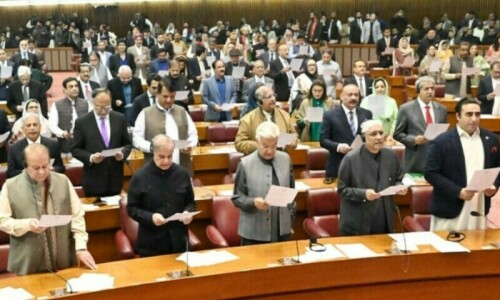
Legal observers are attaching great significance to these observations, particularly against the backdrop of recent legislation by parliament aimed at circumventing the SC’s July 12 verdict in reserved seats case.
The SC noted that while processing the pensioners’ cases, factual verification of pensioners was required.
“We don’t want this court to be burdened with this exercise, which is primarily the function of NBP,” Justice Shah observed, adding that NBP president should depute a focal person to ensure the implementation of the court order in letter and spirit and where required, grant a hearing to the concerned pensioner.
In a constitutional democracy, rule of law is not just a principle but the bedrock upon which the legitimacy of governance rests, Justice Shah observed.
He stated that when the apex court renders a verdict, it does so as the ultimate interpreter of the Constitution. Non-compliance not only disrupts this delicate equilibrium but also sets a dangerous precedent that could lead to executive overreach.
Additionally, the implementation of these orders is crucial for maintaining public confidence in the judicial system, Justice Shah observed.
Courts are seen as the defenders of rights, arbiters of disputes, and interpreters of laws. If their decisions can be easily ignored or sidestepped by individuals or entities, it undermines public trust in the efficacy of the judiciary and, by extension, the entire government, Justice Shah said.
This erosion of trust can lead to a lack of faith in the processes that govern citizens’ lives and, ultimately, in the democratic system itself.
The law of contempt, Justice Shah observed, was a critical tool in this context since it serves to enforce court orders, ensuring that judiciary is respected and that its decisions are not taken lightly.
The power to hold individuals or entities in contempt for failing to comply with a court order is fundamental to the judiciary’s ability to function effectively. Without this power, the judiciary would be rendered toothless, unable to enforce its decisions, thereby jeopardising the administration of justice, he observed.
The individuals or entities have no other choice but to implement the judgement of the court, for in doing so, it upholds the constitution, strengthens democracy, and preserves the public trust in justice and the rule of law.
“Let the nominee keep this constitutional understanding in mind and expeditiously implement the judgement of this court by ensuring that the pensioners are fully paid at the earliest and submit a compliance report before the next date of hearing,” the order concluded.
The court set Oct 15 as the next date for hearing.
Published in Dawn, August 10th, 2024