ISLAMABAD: This month, Pakistan will ask Chinese power plants operating in the country to shift to using Thar coal rather than imported coal, the power minister said on Sunday.
The government may also begin talks on re-profiling the energy sector debt during the visit to Beijing, Awais Leghari told Reuters.
Mr Leghari will be part of the delegation to discuss structural reforms to the power sector suggested by the International Monetary Fund (IMF), which last week agreed on a $7 billion bailout for Pakistan.
The minister declined to elaborate on the possible talks with China over re-profiling energy debt.
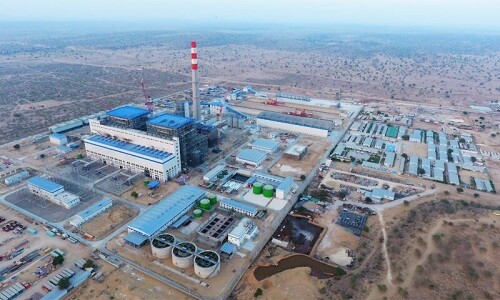
China has set up over $20 billion worth of energy projects in Pakistan.
Energy sector debt re-profiling talks to be held in Beijing this month, says power minister
“One of the key purposes of going along is the conversion of our imported coal units to the local coal. That would have a huge impact on the cost of energy [and] power in the near future. So that is one of the biggest [items on the] agenda,” Mr Leghari said in an interview.
Such a transition would benefit the Chinese-owned plants in Pakistan by reducing pressure on foreign exchange reserves, he said, making it easier to repatriate dividends and offering a better return in dollar terms.
The transition could save Pakistan more than Rs200 billion a year in imports, translating to a decrease of as much as Rs2.5 per unit in the price of electricity, the minister said.
In April, a subsidiary of the Engro conglomerate agreed to sell all of its thermal assets, including Pakistan’s leading coal producer, Sindh Engro Coal Mining, to Liberty Power.
Liberty said the decision stemmed from Pakistan’s foreign exchange crunch and its indigenous coal reserve potential.
The country’s power sector has been plagued by high rates of power theft and distribution losses, resulting in accumulating debt across the production chain — a concern raised by the IMF.
The government is implementing structural reforms to reduce “circular debt” — public liabilities that build up in the power sector due to subsidies and unpaid bills — by Rs100bn a year, Mr Leghari said.
Poor and middle-class households have been affected by a previous IMF bailout reached last year, which included raising power tariffs as part of the funding programme that ended in April.
Annual power use in Pakistan is expected to fall consecutively for the first time in 16 years as higher tariffs curb household consumption, despite summer temperatures surging to near records, which typically boosts air conditioning and fan use.
“We have seen a shrinking demand trend in the past year or year and a half, and we are expecting this to continue unless we rationalise the price of power,” Mr Leghari said, adding that the government’s major challenge was to get demand to stop shrinking.
He said that since the per-unit tariff for power is more expensive, both urban and rural households are moving towards alternatives such as solar.
“Right now, we have close to 1,000 megawatts that are on the grid itself in the form of net metering systems and others. It’s a very conservative estimate that [solar] could be five to six times more than that on the grid right now,” Mr Leghari said.
Published in Dawn, July 22nd, 2024