Israel’s occupation of Palestinian territories ‘illegal’, rules ICJ



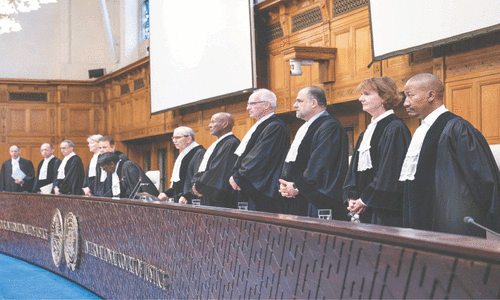
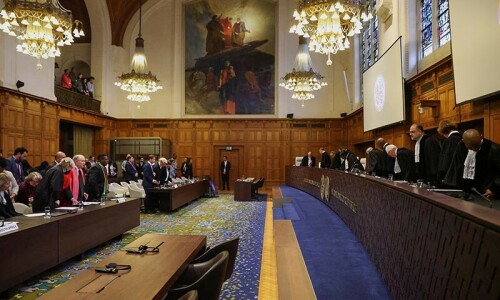
THE HAGUE: The UN’s top court on Friday ruled that Israel’s decades-long occupation of Palestinian territory was “illegal” and needed to end as soon as possible.
The finding by The Hague-based International Court of Justice was immediately welcomed by the Palestinian leadership which called it “historic”, but slammed as a “decision of lies” by Israel.
The ICJ’s statement, called an “advisory opinion”, is not binding, but it comes amid mounting concern over the death toll and destruction in Israel’s war against Hamas sparked by the group’s Oct 7 attack. It comes in response to a UN General Assembly query in 2022 regarding the legal consequences of Israel’s “prolonged occupation, settlement and annexation of the Palestinian territory occupied since 1967”.
The ICJ’s finding is also likely to increase diplomatic pressure on Israel, whose lawmakers voted on Thursday to oppose a Palestinian state, calling it an “existential threat”.
Palestinians welcome finding as ‘watershed moment,’ ‘historic’; Tel Aviv assails it as a ‘decision of lies’
In The Hague, ICJ presiding judge Nawaf Salam said: “The court has found that Israel’s continued presence in the Palestinian Territories is illegal.”
Israel is “under the obligation to bring to an end its unlawful presence as rapidly as possible,” the judge said at the Peace Palace, seat of the ICJ.
The ICJ added that Israel was “under an obligation to cease immediately all new settlement activities and to evacuate all settlers” from occupied land.
Israel’s policies and practices, including the building of new settlements and Israel’s continued maintenance of a wall between the territories, “amount to annexation of large parts” of the occupied territory, the court said.
Israeli Prime Minister Benjamin Netanyahu slammed the ICJ’s opinion as a “decision of lies.”
“The Jewish people are not occupiers in their own land — not in our eternal capital Jerusalem, nor in our ancestral heritage of Judea and Samaria” (the occupied West Bank), Netanyahu said in a statement.
“No decision of lies in The Hague will distort this historical truth, and similarly, the legality of Israeli settlements in all parts of our homeland cannot be disputed.”
Palestinian Foreign Minister Riyad Al-Maliki called the ICJ’s ruling a “watershed moment”.
“The Palestinian people have endured unbearable suffering and injustice for decades,” Al-Maliki told reporters outside the courtroom.
A separate, high-profile case that South Africa brought before the court says Israel has committed genocidal acts during its Gaza offensive.
Published in Dawn, July 20th, 2024