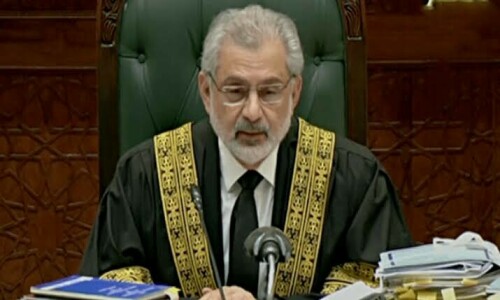
ISLAMABAD: Justice Athar Minallah has asked the Election Commission of Pakistan (ECP) to satisfy the Supreme Court that the Pakistan Tehreek-i-Insaf (PTI) was excluded from the electoral process legitimately, thereby forfeiting its claim to reserved seats.
As a member of the full-court bench of the Supreme Court hearing the Sunni Ittehad Council’s (SIC) appeal against the denial of reserved seats for women and minorities, Justice Minallah directed the ECP to satisfy the court that a level playing field was provided to all political parties, including PTI, before, during, and after the February 8 general elections.
The SC will resume hearing the appeal on Monday.
In a four-page note, Justice Minallah observed that petitions pending before the SC raising questions about the integrity of the Feb 8 polls should be heard alongside the SIC petitions. He directed the ECP to place on record the nature of complaints received prior to, during, and after the general elections and satisfy the apex court that each political party was treated in accordance with the Constitution’s command, providing a level playing field to all.
SIC tells top court BAP was allocated reserved seats in 2019 even though it didn’t contest elections from KP
Justice Minallah said the question of reserved seats could not be decided in isolation or based on technicalities and pleadings. According to him, the larger issue involves the fundamental democratic and constitutional right of the real stakeholders — the voters. As they are not before the bench and as the highest court vested with jurisdictions under articles 184(3) and 187 of the Constitution, the approach ought to be inquisitorial. He said the Supreme Court was the custodian of the rights of people and the right to vote was one of the most important fundamental rights.
All other rights become illusory and the Constitution is gravely violated when voters are disenfranchised, if the ECP fails in its duty to conduct the elections in accordance with the mandate of the Constitution, according to him.
The Constitution has vested the exclusive extraordinary jurisdiction under Article 184(3) in addition to doing complete justice in the exercise of the duty conferred under Article 187, Justice Minallah said, adding that the apex court could not be a slave to technicalities in a matter of such public importance that affects every citizen and the future of the country.
As petitions were pending before the SC challenging the integrity of the electoral process during the general elections and the alleged violation of the fundamental rights of voters and political workers, the court could not turn a blind eye by ignoring such matter, he noted.
The SC could not and must not be seen as ignoring the elephant in the room, Justice Minallah observed, adding that it could not be perceived as being complicit in the alleged failures of the ECP to conduct credible elections as mandated under the Constitution.
It was the onerous duty of the SC to ensure that no voter was disenfranchised and questions regarding the integrity of the electoral process were not ignored, he said. But, he added, the arguments advanced by the ECP’s counsel had raised grave questions regarding the integrity of the electoral process.
The exclusion of a major political party from the general elections by the ECP, on the basis of its flawed interpretation of Jan 13, 2024 Supreme Court judgement, definitely had the consequence of the disenfranchisement of voters and thus deprivation of the reserved seats.
The legitimacy of governance, future policies, legislation, and public trust in representative institutions depend on the integrity of the electoral process and institutions. The ECP’s alleged failure to discharge this duty would raise questions about fulfilling their constitutional obligation to conduct elections.
Meanwhile, the SIC, which is fighting for the allotment of reserved seats before the SC, highlighted that the ECP had in 2019 allocated reserved seats to the Balochistan Awami Party (BAP) even though the party had not contested polls from Khyber Pakhtunkhwa nor submitted a list of candidates for reserved seats for women. The ECP applied different standards in allocating reserved seats to BAP in the KP Assembly in 2019, but took a discriminatory step by not allocating reserved seats for women and minorities to the SIC.
The application requested the KP government be allowed to furnish additional documents necessary for the just disposal of the case.
Published in Dawn, June 30th, 2024