Bolivian President Luis Arce denies conspiracy after failed coup

Bolivian President Luis Arce on Thursday denied conspiring with his former army chief, who was arrested after deploying troops and tanks to the heart of the capital La Paz, where they tried to break down a door of the presidential palace.
Fourteen civilians who opposed the coup were wounded by gunfire, according to the authorities. Some had to be hospitalized and operated on, Luis Arce told the press.
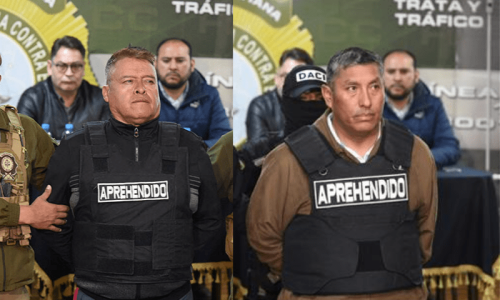
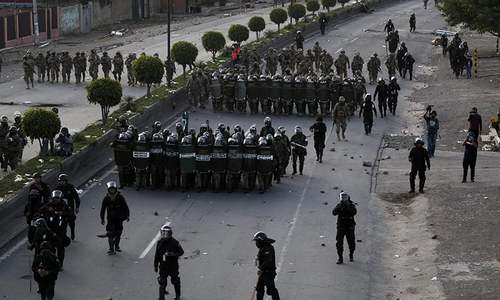
Authorities paraded handcuffed detainees in front of the media on Thursday, announcing 17 arrests including ex-army chief Juan Jose Zuniga, and riot police kept close watch over government buildings a day after the botched coup.
Tensions in the Andean nation have been rising in recent weeks over surging prices, shortages of dollars and fuel, and a feud between President Luis Arce and the powerful former president Evo Morales ahead of the 2025 election.
In his first public appearance since announcing the coup attempt was over Wednesday night, Arce denied he had conspired with Zuniga. The army chief claimed he was following orders and that the president had hoped to trigger a crackdown that would boost his popularity.
“How could one order or plan a coup on one’s self?” Arce told reporters.
Flanked by soldiers and tanks outside the presidency, Zuniga said that “the armed forces intend to restructure democracy, to make it a true democracy and not one run by the same few people for 30, 40 years.”
Shortly thereafter, the soldiers and tanks pulled back from the historic Plaza Murillo square and local television broadcast images of Zuniga’s arrest.
Bolivia’s naval chief, Juan Arnez Salvador, was also arrested. The two men face up to 20 years in prison for the crimes of terrorism and armed uprising, prosecutors said.
Defend democracy
Interior Minister Eduardo del Castillo announced a total of 17 arrests, including active and retired military personnel and civilians, in connection with the attempted coup. Other suspects are still being sought.
The government broadcast a conversation between Arce and Zuniga at the doors of the presidential mansion, surrounded by military personnel, in which Arce ordered his army chief to withdraw his troops to their barracks.
Zuniga replied with a blunt “No,” but left the presidential palace a few minutes later.
“We are going to defend democracy and the will of the Bolivian people, whatever the cost!” the 60-year-old Arce wrote on social media platform X. He has since sworn in new military leaders.
The coup plot, however, took an unusual twist as Zuniga told reporters that Arce had ordered a staged uprising in order to trigger a crackdown that would make him look strong and “raise his popularity.”
“It is absolutely false,” said close presidential aide Maria Nela Prada.
Former centrist president Carlos Mesa, who was in power from 2003-2005, wrote on X that the troop deployment “resembles a farce.”
Brazilian president, Luiz Inacio Lula da Silva announced Thursday that he would soon visit his “friend” Arce to support him following the unrest.
In an interview with Itatiaia radio, Lula said he would travel to the Bolivian city of Santa Cruz de la Sierra to “strengthen Luis Arce, strengthen democracy.”
Russia “strongly” condemned the attempted military coup, its foreign ministry said on Thursday, warning against “destructive foreign interference” in the South American country.
UN chief Antonio Guterres “welcomes the peaceful resolution of the situation,” his spokesman Stephane Dujarric said, having earlier expressed alarm over the abortive coup.
Condemnations of the coup bid also poured in from Madrid, Washington and across Latin America.
Political tug of war
Bolivia, which has a long history of military coups, has in recent weeks been rocked by an economic crisis due to a drop in natural gas production, its main source of foreign currency until 2023.
The country has had to reduce fuel imports and there is a shortage of dollars, which has triggered protests by powerful unions of merchants and freight transporters.
Gustavo Flores-Macias, a professor of government at Cornell University in New York state, told AFP the failed coup was “a symptom of a significant and broad discontent” in the country.
For now, “we must carefully evaluate how widespread the discontent is within the armed forces,” he said, adding that Arce’s government was facing “a critical moment of weakness.”
Bolivia is also deeply polarized after years of political instability, and the ruling Movement Towards Socialism party is riven by internal conflict between supporters of Arce and his former mentor Morales.