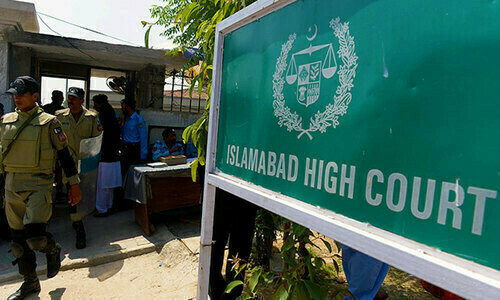
ISLAMABAD: Justice Babar Sattar of the Islamabad High Court has reserved a verdict on the capital’s police’s request to allow surveillance of suspects, after a crime has been committed.
While appearing before the court on Tuesday, Islamabad Police’s Director Law Tahir Kazim said that after the court’s order against surveillance last month, cellular companies have stopped sharing “much-needed data” required for routine criminal investigations.
He was referring to the judge’s order on May 30, where he stated that no state official was authorised to surveil citizens and anyone doing so or aiding such actions would be “liable for offences”.
The judgement had also barred telecom companies and service providers from sharing data with police and intelligence agencies till next hearing.
Islamabad police official says telcos have stopped sharing call detail records following IHC’s order last month
The order was issued on petitions filed by ex-premier Imran Khan’s spouse, Bushra Bibi, and Najam Saqib, the son of former chief justice of Pakistan Saqib Nisar, against audio leaks allegedly featuring them.
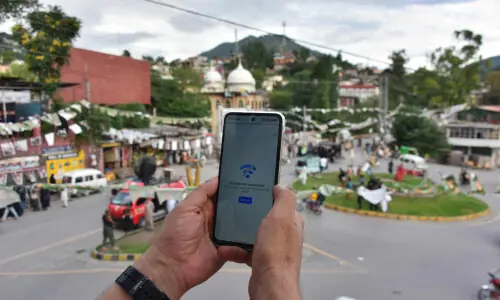
In compliance with the court’s directive, cellular companies stopped sharing Call Detail Records (CDR) with law enforcement agencies.
According to law enforcement agencies, the judge’s order resulted in several investigations being stalled as they rely on CDRs to trace criminals, terrorists, and abductees.
As Justice Sattar resumed the hearing on the petitions on Tuesday, he said spying was different from “post occurrence” sharing of data; however, cellular companies were treating both scenarios equally.
Mr Kazim, the capital police’s director law, added that in the aftermath of any incident, there is no restriction to get technical data from telecom companies.
He also denied that the Islamabad police conduct technical surveillance or record calls.
When Justice Sattar asked whether police seek a warrant before collecting technical data, Mr Kazim replied that the force always requests data in post-occurrence scenarios — after the crime has been committed.
The judge remarked that he didn’t pass the order with respect to the information about terrorists. However, the court would have to be apprised under which laws surveillance is being conducted since the federal government is constantly changing its stance.
During the hearing, Additional Attorney General (AAG) Barrister Munawar Iqbal Duggal argued that the government has delegated power to LEAs to contact telecom companies to collect CDR and other data.
AAG Duggal also told the court that the Ministry of Interior (MOI) has permitted intelligence agencies, ISI and IB, to collect the data.
Justice Babar Sattar questioned how MOI could issue such directions and how the live location of an individual can be shared without a warrant.
Counsel for the Pakistan Telecommunication Authority (PTA) said his client neither allowed any agency to record calls nor it does any surveillance.
PTA is only a regulatory body, the counsel added.
A counsel for telecom companies told the court that sharing technical data is one of PTA’s conditions for granting licences to telecom operators, and they are bound to install the required technical system at the regulator’s behest.
Published in Dawn, June 26th, 2024