0
0

ISLAMABAD: Pakistan’s bid to join the BRICS economic bloc marks the country’s significant strategic intent to position itself alongside the world’s burgeoning and influential economies, besides underscoring its aspiration to be an integral player in the ascendant collective of the Global South.
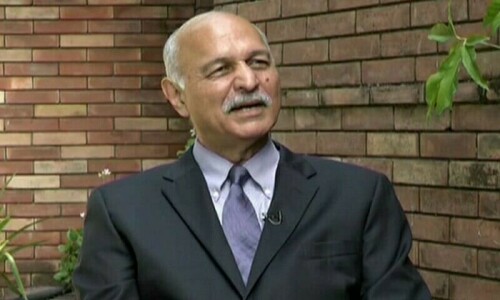
This was stated by Mr Mushahid Hussain Sayed, a former senator and head of Pakistan-China Institute and Pakistan-Africa Institute for Development & Research, at the International BRICS Forum held in Russian far eastern port city of Vladivostok.
The two-day forum was organised by Russia’s ruling ‘United Russia’ Party.
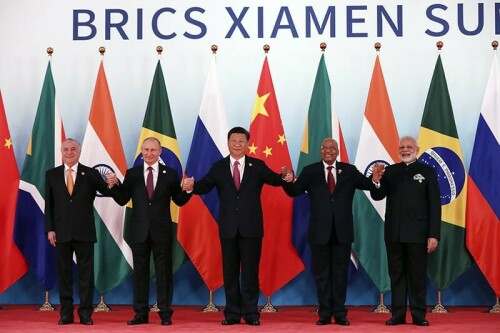
In November of last year, Pakistan officially applied for membership in BRICS, a coalition of emerging economies — Brazil, Russia, India, China, and South Africa. The bloc last year accepted four new members — Egypt, Ethiopia, Iran and the United Arab Emirates — and came to be known as BRICS Plus. Islamabad’s application coincided with BRICS growing recognition as a prominent group representing the Global South.
Pakistan is among the 29 more countries that have applied for membership in BRICS, a group representing nearly half the world’s population and accounting for 30 per cent of the global GDP. Additionally, 50pc of the world’s oil and gas producers are members of this bloc.
Mr Sayed said that an expanded BRICS could significantly shape contemporary international relations in three major ways. First, he envisioned it promoting the democratisation of international relations, fostering dialogue and relationships among states based on equality and the rule of law, as opposed to hierarchical power dynamics.
Second, he suggested that BRICS could lead to the demilitarisation of international relations, countering the current Western-led order, which he characterised as mired in a new Cold War hysteria. This includes militaristic policies like arming Israel, promoting an ‘Asian Nato’, and forming groups like QUAD and AUKUS aimed at containing China and Russia.
Third, Mr Sayed discussed the dedollarisation of the international financial system, highlighting how the US uses the dollar as a political weapon. He pointed out that 68 of the 193 UN member states have already started moving away from the US dollar, with significant shifts like Saudi Arabia ending its 50-year-old agreement with the United States to only trade oil in dollars, now opting for non-dollar currencies.
Through these changes, Mr Sayed saw BRICS potentially reducing US economic influence globally and advancing a more multipolar world order.
Mr Sayed said that that the ’post World War II Western-propped global economic and political order was already unraveling and organisations like BRICS and Shanghai Cooperation Organisation (SCO) would be the pillars of this emerging new global order.
On the need for a new approach to security issues, he welcomed the June 14 initiative of President Putin for a new Eurasian Security paradigm based on indivisible security of nations so that no one country’s security can be at the expense of others.
He also lauded a similar endeavour of President Xi Jinping for a ‘Global Security Initiative’.
Published in Dawn, June 20th, 2024