China views Taiwan’s ‘elimination’ as national cause, President Lai Ching-te says


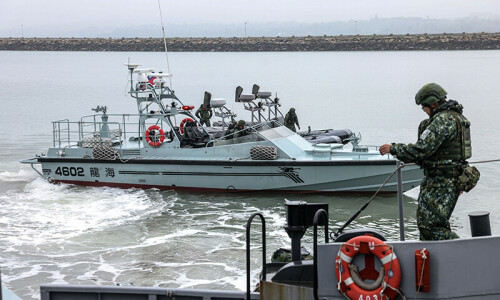
China views the annexation and “elimination” of Taiwan as its great national cause, Taiwan President Lai Ching-te said on Sunday, telling cadets at the military’s premier academy they must know their enemy and not give in to defeatism.
Lai has faced sustained personal attacks from China, which views Taiwan as its own territory, since assuming office last month, with Beijing calling him a “separatist”. China staged war games around Taiwan shortly after Lai’s inauguration.
Lai says only Taiwan’s people can decide their future and has repeatedly offered talks with Beijing but has been rebuffed.
Speaking in Kaohsiung in the south of the island on the 100th anniversary of the founding of the Whampoa Military Academy, Lai said today’s cadets must recognise the challenges of the “new era”.
“The biggest challenge is to face the powerful rise of China, [which is] destroying the status quo in the Taiwan Strait and regards Taiwan’s annexation and the elimination of the Republic of China as the great rejuvenating cause of its people,” he said, using Taiwan’s formal name.
China’s Taiwan Affairs Office did not answer calls on Sunday seeking comments about Lai’s remarks.
Wang Huning, the fourth-ranked leader in China’s ruling Communist Party, told a Saturday forum in China about relations with Taiwan that “reunification is a historical necessity for the great rejuvenation of the Chinese nation”, vowing to “smash any separatist plots”.
Lai, at the event attended by senior military officials and also the top US diplomat in Kaohsiung Neil Gibson, said the cadets must defend Taiwan against being annexed by China and that the island’s future can only be decided by its people.
“We really must be able to distinguish between ourselves and our enemies and between friend and foe, and absolutely cannot accept the defeatism of ‘the first battle is the last battle’,” Lai said, referring to a theory that Taiwan could collapse as soon as China launched any attack.
The academy was founded in China’s Guangzhou — then known in English as Canton — in 1924, more than a decade after the establishment of the Republic of China, which overthrew the last emperor.
Set up with the help of the Soviet Union to give China a professional military loyal to the nascent state, it moved to Nanjing, Chengdu and finally, Kaohsiung, after the defeated Republican government fled to the island in 1949 at the end of a civil war won by Mao Zedong and his communist forces.
China says any move by Taiwan to declare formal independence would be grounds to attack the island. The government in Taipei says Taiwan is already an independent country, the Republic of China, and that it does not plan to change that.