0
0

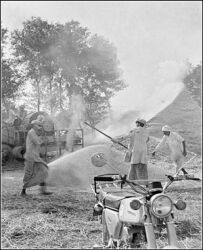 THE country faces a crisis whether there is a surplus or a shortage. The people are upset when there is a crop shortfall and cry hoarse when they face abundance. Placed in a paradoxical position, where the nation ends up losing both in case of good or a bad crop. Money is spent on subsidy irrespective of a surplus or a shortage. Total subsidies on supporting the quixotic policy in 2001-02, 2002-03 and 2003-04 were Rs9 billion, Rs12 billion and Rs11 billion respectively. That is not counting the direct expenditure on maintaining four provincial food departments and a huge monolith of Passco.
A spate of news items has forecast a crisis because good crop is accompanied by ‘cash credit constraints, a carryover stock of three million tons and subdued activity in the private sector is anticipated.
On the face of it we should be rejoicing that we won’t have to import food this year, thereby saving foreign exchange, the grower will have more income by selling larger volume and consumer will have to pay less. Incidentally the alarmist report is based on sources like the officials and the Pakistan Flour Mills Association (PFMA), both of which have no interest in the welfare of common man. They have their own vested interests to advance.
The huge carry-over and stuck-up loans of Rs40 billion demonstrate incompetence of the officials handling the commodity in the provincial food departments. Their role should be of stabilizer. They should be swing players to buy from the grower at a minimum guaranteed price if the private sector shows lack of interest and release stocks when the market is heating up, may be, for reasons of hoarding and cartelization by the private sector.
They ought to have released their stocks into the market to dampen the sentiment when there was scarcity and prices rising. Instead they forced the federal government to import, and are now blaming for their short-sighted approach.
Imposition of export duty was of course an unwise step, which besides distorting free market closed the Afghanistan market to us, Russia, Central Asia and India replacing us. The same officials recommended this too. But private trade, which brings in foreign exchange even if we have to import wheat, should be considered a legitimate activity. Criminalizing this trade with Afghanistan only whets the appetite of the agencies charged with anti- smuggling duties.
One reason blamed for the so-called crisis by the PFMA is faulty crop assessment. But that should not be a major factor. With the given means, estimates cannot be any better. Far worse are the ham handed policies of the food departments and Passco (the latter a military outfit embedded with the ministry of food and agriculture), which operate in the Second World War mind set.
The government intervention in the Sub-continent dates back to the Great War, when it procured wheat and other food grains at fixed price from the growers. Under this system the movement of specified commodities from one area to another was restricted and the farmers were prohibited to sell except to the government. If any farmer was found contravening, he faced punitive action. After the creation of Pakistan the same policy has remained in vogue. Prices fixed are usually much lower than the free market price.
During 2003-04, 1.5 millions tons were imported and a subsidy Rs13 billion was paid. This was an indirect subsidy to the grower in the exporting countries. We are prepared to subsidize the grower of Australia or the US or Russia but not our own. We are not prepared to buy wheat in India either, where the element of subsidy would have been much lower. We tend to treat Indian grower wholly unworthy of our commercial consideration even if we hurt ourselves in the process by buying dearer elsewhere.
Interestingly, we paid subsidy in 2001-02 and 2002-03 when we exported. This was because we did not allow the private sector to export to Afghanistan because it constituted ‘smuggling’. When the state finally decided to do it, our stocks had deteriorated and the prices had come down. That is how the public sector works. Any trade with Afghanistan including export of wheat can be to the mutual benefit of both the countries.
The food departments and Passco buy the commodity by adopting coercive methods and withhold it when there is scarcity simply because they do not want to expose themselves to greater shortage in the future. All decisions are designed to aggravate the situation by distorting the market.
Procurement by the food departments, Sindh and Punjab is propelled by zeal to support the grower and help the urban consumer. Distinction between Procurement Price (PP) and Support Price (SP) is completely ignored, that has to be at par with the market price, and the latter a guaranteed minimum price in case prices fall below a ‘desirable level’.
Support price (SP) for 2003-04 had been fixed at Rs415 per 40kg. It becomes a punishment price when the grower is forced to sell at that price to the department if market price is higher. When prices fall below the SP as it did in the year 2000, the subsidy, instead of going to the small farmer, is shared by the big farmers and the officials as ‘transaction cost’.
Ban on movement of wheat caused the prices to crash in the market below SP and instead of helping the farmer hurt him. The food agents ‘arhtis’ and the food department employees usually make money in such a situation as they did during glut of 2000.
Now, the free trade is the dogma of economists. As a result out of nine commodities for which APCom used to fix prices, only two commodities i.e. wheat and cotton are left to be covered under the support price regime.
The Agricultural Prices and Policy Commission (APCOM) in a landmark survey relating to the year 1997-98 exposed the fallacy of the entire edifice of support price structure.
The survey is based on a sample, limited to 16 Tehsils in Punjab and six Tehsils, known as Talukas in Sindh. These cover 79 villages in Punjab and 27 in Sindh. Inqilab-91 variety of wheat is the most popular in Punjab, sown over 75 per cent areas. But in Sindh it does not enjoy as much popularity, with only 24 per cent area devoted to this variety. Marketable surplus was 55 per cent of the total production in Punjab against 42 per cent in Sindh.
Interesting part of the survey is that a very small percentage of farmers sell their marketable surplus of wheat at the procurement centres (PCs). About 74 per cent respondents in Punjab sold their surplus either at the village or the ‘mandi.’ Only 21 per cent farmers sold their crop at the PCs.
Comparable figures for Sindh are just about the same as far as the PCs are concerned. In Punjab, 30 per cent of the marketable surplus was sold by 15 per cent of the farmers at the PCs. As for Sindh, the figures were 38 per cent and 21 per cent respectively.
Table shows some more details.
For the future, the government may have to discontinue the present system, being both expensive and disruptive of the market. Methods based on market forces are generally admitted to be more efficient and effective both for stabilizing prices and enhancing food production. As part of this programme, a distinction will have to be made between the guaranteed minimum price (GMP) and the procurement price (PP).