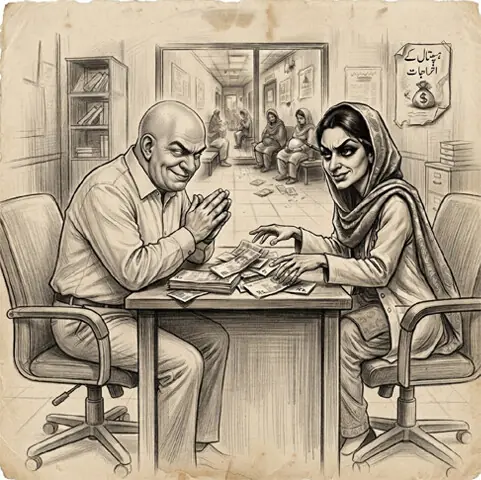
THERE is a talk of payment worth millions of ruppes to the power producers as capacity charges. People are seen and heard arguing that they are paying the capacity charges despite the fact that not a single unit is generated by any power producer. In this context, people should realise that power plants were installed as per the policy in vogue at that particular time.
The installation process of a power plant requires a lot of investment. The thermal power plant’s useful life is mostly around 25 years. So, anyone who is going to install a power plant has to engage human resources, entering into long-term contracts for supply of fuel, selling of power, and carrying out operation and maintenance tasks. These things are financed by the tariff approved by the National Electric Power Regulatory Authority (Nepra).
Power plants operate as per the demand of the system operator, which in this case is the National Power Control Centre (NPCC). Sometimes the power demand is low, and the plant may be shut down as per the merit order. It is restarted once the demand increases.
Should the owner of the plant lay off employees if the plant is shut down for, say, 5-10 days? Does the power plant stop debt servicing on the loans obtained from financial institutions? Or does the power company terminate its operations and maintenance agreements for a few days and then bring them back again when the demand increases? All these costs are covered under the capacity charges, and, hence, cannot be stopped.
Moreover, the capacity payments are mostly covered under fixed operations and maintenance costs in the tariff part, composed of smaller charges compared to the fuel cost component or energy purchase price. This is not as big an issue as is being generally portrayed by the public.
Further, what is a matter of concern is the continuing operation of less efficient plants. Steps should be taken to convert the inefficient plants into efficient systems to avoid the production of costly electricity.
Umair Ahmed Khan
Deputy Manager (Technical)
GENCO Holding Company
Islamabad
Published in Dawn, June 3rd, 2024