Iranian president arrives for three-day visit today



• FO says visit first by any head of state after Feb 8 polls
• Raisi to meet President Zardari, PM Shehbaz, Senate chairman
• Will also head to Lahore and Karachi to meet provincial leaders
ISLAMABAD: Iranian President Ebrahim Raisi is set to arrive in Pakistan today (Monday) for a three-day official visit, the Foreign Office said in a statement on Sunday.
“President of the Islamic Republic of Iran will undertake an official visit to Pakistan from April 22 to 24, 2024,” the official statement said.
This visit, the first by any head of state to Pakistan after the Feb 8 general elections, comes amid escalating tensions in the Iran-Israel conflict.
During his visit, the Iranian president will be accompanied by his spouse and a high-level delegation comprising the foreign minister, other cabinet members, senior officials and a large business delegation.
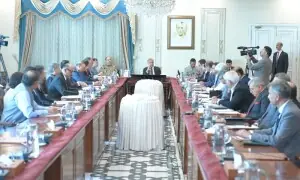
Mr Raisi will meet President Asif Ali Zardari, Prime Minister Shehbaz Sharif, Senate Chairman Yousuf Raza Gilani, and National Assembly Speaker Ayaz Sadiq. He will also visit Lahore and Karachi and meet with the provincial leadership.
“The two sides will have a wide-ranging agenda to further strengthen Pakistan-Iran ties and enhance cooperation in diverse fields including trade, connectivity, energy, agriculture, and people-to-people contacts,” the Foreign Office said.
“They will also discuss regional and global developments and bilateral cooperation to combat the common threat of terrorism,” it said, adding that the two countries enjoy strong bilateral ties anchored in history, culture and religion. “This visit provides an important opportunity to further strengthen Pakistan-Iran relations,” it said.
Mr Raisi’s visit to Pakistan had been in doubt as Middle East tensions rose after Iran launched an unprecedented missile and drone attack on Israel a week ago in retaliation for an airstrike on the Iranian consular building in Damascus earlier this month. Then, on Friday, central Iran received what was presumed to be an Israeli attack.
Tehran has played down the apparent Israeli attack and indicated it had no plans for retaliation, a response that appeared gauged towards keeping the Gaza war from expanding to a regionwide conflict.
Pakistan has called on all parties in the Middle East to “exercise utmost restraint and move towards de-escalation”.
Cross-border strikes
Mr Raisi’s visit is also significant as Pakistan and Iran seek to mend ties after tit-for-tat missile strikes in January. The cross-border strikes stoked regional tensions already inflamed by the Gaza war.
Tehran carried out the strikes against an anti-Iran group in Pakistan the same week it targeted Iraq and Syria. Pakistan responded with a raid on “militant targets” in Sistan-Balochistan province.
Both countries have accused each other of sheltering militants in the past.
Iran-Pakistan pipeline
Pakistan is also counting on a joint gas project with Iran to solve a long-running power crisis that has sapped its economic growth.
A $7.5 billion Iran-Pakistan gas pipeline intended to feed Pakistani power plants was inaugurated with great fanfare in March 2013. But the project immediately stagnated following international sanctions on Iran.
Tehran has built its own section of the 1,800-kilometre pipeline, which should eventually link its South Pars gas fields to Nawabshah.
In February, the outgoing caretaker government in Pakistan approved the construction of an 80km section of the pipeline, primarily to avoid the payment of billions of dollars in penalties to Iran due to years of delays.
Washington has warned that Pakistan could face US sanctions, saying it does not support the pipeline going forward.
Published in Dawn, April 22nd, 2024