Deadly strike on Iran consulate ‘crossed a line’: analysts


BEIRUT: A deadly strike blamed on Israel against Iran’s diplomatic mission in Damascus could trigger a spillover of the Gaza crisis across the region, an escalation Tehran had sought to avoid, analysts said.
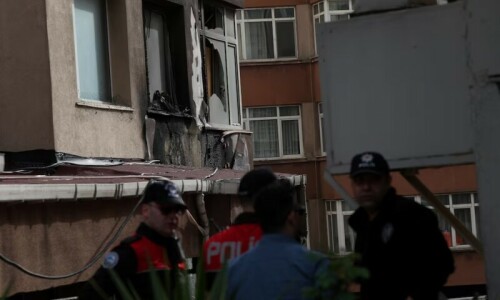
Monday’s strike levelled the consular annex of the Iranian embassy and killed 13 people, including seven members of Iran’s Islamic Revolutionary Guard Corps (IRGC), Iranian state media reported.
They included two senior commanders of the Guards’ Quds Force foreign operations arm, Brigadier Generals Mohammad Reza Zahedi and Mohammad Hadi Haji Rahimi, Iranian officials said. Ali Vaez of the International Crisis Group called the attack “a significant escalation”. “By targeting an Iranian diplomatic facility, Israel has crossed a line,” he said.
After months of aggression in Gaza, Israel is now stepping up its operations against Iranian and pro-Iran commanders in Lebanon and Syria, a move observers fear could spiral into all-out war.
Say Netanyahu thinks Israel will have to fight ‘war with Iran’ and he wants US to join it
Although Iran has said it wants to avoid full-scale war, supreme leader Ayatollah Ali Khamenei warned on Tuesday that “Israel will be punished” for the Damascus strike, while President Ebrahim Raisi said the raid “will not go unanswered”.
‘Transnational war’
The Damascus strike could signal that Israeli Prime Minister Benjamin Netanyahu, entangled in Gaza for nearly six months, is preparing for a wider regional conflict.
Under pressure from Washington, “Netanyahu is running out of time to conduct the war in Gaza, and is instead turning to Lebanon and Syria to weaken the Iranian regional military effort,” said Nick Heras of the New Lines Institute for Strategy and Policy. “Israel views the conflicts against Hamas in Gaza and Hezbollah in Lebanon as two fronts in a transnational war against Iran, which the Iranians run from Damascus,” Heras added. He said Netanyahu “expects Israel to have to soon fight a region-wide war with Iran” and for the United States to join it.
“The Israelis are trying to eliminate the most important and seasoned IRGC commanders to weaken Iranian planning and capabilities ahead of that war,” he added. But diplomatic efforts are underway to de-escalate tensions, with Syrian ally Russia calling for a UN Security Council meeting on the strike.Washington has told Tehran it was not involved in the Israeli strike, according to an American official quoted by US media outlet Axios.
Bassam Abu Abdallah, who heads the Damascus Centre for Strategic Research and is close to the Syrian government, said that, “there were rules of engagement, but now it’s an all-out war between Israel and the resistance axis”. “It is now clear that the trend is towards escalation,” Abu Abdallah said, adding: “We could start to see increased attacks against US bases in Syria, Iraq or elsewhere.” In late January, pro-Iran groups said they were suspending attacks against US troops in Iraq and Syria to avert a regional escalation, after both Baghdad and Tehran said they opposed the groups’ campaign.
On Tuesday, Hezbollah warned that the strike on the Iranian consulate “will not pass without the enemy receiving punishment and revenge”.
Published in Dawn, April 3rd, 2024