ISLAMABAD: Pakistan’s Malaria Control Programme will train nine African countries to deal with a mosquito, native to South Asia, which may lead to a rapid increase in Malaria cases in the continent.
The decision was made after confirmation that an Indian-origin mosquito, which had existed in the subcontinent since long before partition, had reached Africa and was multiplying.
“The Indian-origin mosquito named Anopheles stephensi was reported in Africa over a decade ago but during the last few years, it has rapidly spread in the continent and may further increase the malaria cases,” Dr Muhammad Mukhtar, the head of Directorate of Malaria Control, Pakistan, told Dawn.
It is feared that Africa, which already contributes 92 per cent of global Malaria cases every year, may further suffer because of the new mosquito, which never existed in the continent historically.
He said that although the mosquito has existed in the subcontinent since pre-Partition, the genome sequencing (DNA testing) of the species by the London School of Hygiene confirmed that it reached Africa from India.
Genome sequencing is a technique used to identify the area or origin of viruses and living organisms. It has been widely used to trace poliovirus cases reported in Pakistan and Afghanistan and identify the virus’ country of origin. Within a country, it can help determine the province or division to which the virus belongs.
Directorate of Malaria Control’s Dr Mukhtar said an international body, Asia Pacific Malaria Elimination Network (APMEN), has selected Pakistan to train the nine African countries to deal with the mosquito.
He said it was an honour for Pakistan and the Ministry of National Health Services that the organisation’s Vector Control Working Group selected Pakistan for the training.
The recognition was due to the country’s efforts in “controlling the mosquito over the years”.
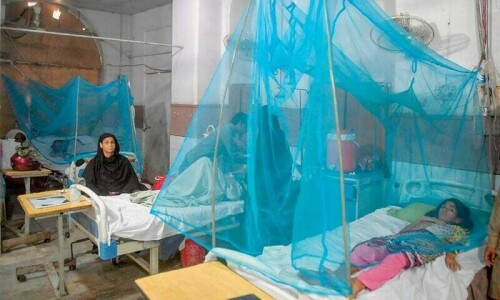
He said there were only 375,000 reported malaria cases in 2021, but the number went up to 3.2 million after the 2022 floods, he said, adding that the number has started declining again.
According to Dr Mukhtar, the majority of malaria cases in Pakistan were reported from Balochistan, Sindh and former Fata. In Punjab, cases were mostly reported in some districts of south Punjab.
“We can train the African countries because of our experience in dealing with the mosquito,” Dr Mukhtar said, adding that the National Entomological Reference Laboratory in Islamabad which will be used to train teams of African nations regarding policy, strategy, surveillance and other steps to quell the mosquitoes.
The teams will also be taken to the mosquito breeding areas in south Punjab for field visits and practical knowledge, he added.
Initially, teams of four or five countries will arrive, while the remaining will visit the country in the second phase.
Published in Dawn, March 25th, 2024