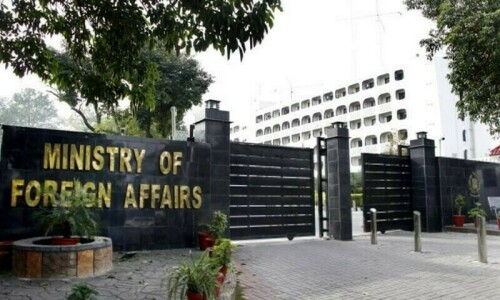
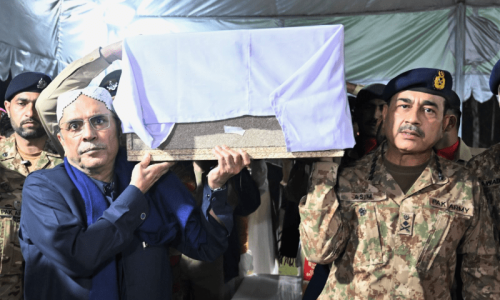
RELATIONS between the newly formed government and Afghanistan’s de facto Taliban rulers have begun on an inauspicious note. After seven security personnel were martyred in a terrorist attack in North Waziristan on Saturday, Pakistan hit targets in Paktika and Khost provinces early on Monday targeting “terrorists belonging to [the] Hafiz Gul Bahadur Group”, according to an FO statement released yesterday.
Afghan officials, on the other hand, claimed “civilian homes” had been struck. Moreover, there were reports of cross-border exchanges of fire in Kurram district on Monday. Militants had also staged attacks in Mohmand, Nowshera and Bannu over the weekend.
What is important at this juncture is that matters do not escalate with Kabul. While terrorist attacks targeting civilians as well as security personnel are a red line and cannot go unanswered, and the frontiers must be defended, unilateral action should not become the norm. This will only cause further deterioration of ties with the Afghan Taliban, and Pakistan may lose whatever leverage it has with Kabul, adding to our security concerns.
Soon after the new government took over, there was a routine exchange of pleasantries between the foreign minister and his Afghan counterpart, as both vowed to expand cooperation in various sectors, including security. The North Waziristan attack and its fallout, however, have come as a painful reality check, and are the government’s first test on the Afghan front of its management of relations with Kabul.
Both sides must verify where the attacks targeting Pakistan originated from. While Afghan Taliban officials insist their territory is not being used by terrorists, there is a lot of evidence suggesting otherwise. Pakistan has raised the issue of militant sanctuaries in Afghanistan at the UN whose officials have similarly highlighted the presence of numerous militant groups in Afghanistan.
Instead of feigning ignorance, the Afghan Taliban should take action to stop anti-Pakistan fighters from launching attacks inside this country, especially if they are serious in their quest to be accepted as Afghanistan’s legitimate government. While clear threats to national security must be immediately neutralised, Pakistan has to use carrots and sticks with the Taliban to permanently solve the militancy problem.
The FO has hinted at a similar line of action and of working “towards finding joint solutions in countering terrorism”. Communication channels should remain open, and Pakistan should ask Afghanistan to take action against verified terrorist sanctuaries across the border. Moreover, China, which offers a financial lifeline to the Kabul regime, can also be asked to take punitive measures if the Taliban refuse to crack down on militants on their soil.
The terrorist threat from Afghanistan-based groups can destabilise the entire region, which is why all regional states should work on a common counterterrorism agenda with Kabul, along with using bilateral channels.
Published in Dawn, March 19th, 2024