Lahore Aurat March turns political, demands election results transparency

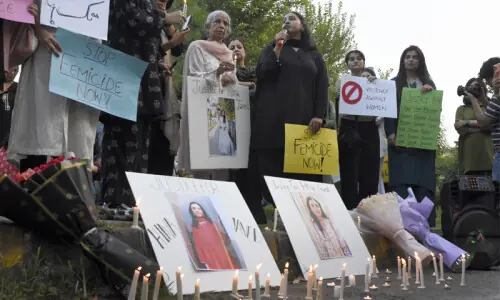
LAHORE: Hundreds of women took to the streets in Lahore as a part of the Aurat March to demand their rights and freedoms on the International Women’s Day on Friday.
This year’s charter focused on political demands also in the wake of the controversial general election, including transparency in poll results and an increase in the number of women seats.
The Aurat March raised a voice for the end of enforced disappearances in the country, endorsing the Baloch March against Genocide. It sought an end to surveillance systems such as the ‘safe city’ projects, saying they perpetuated a paternalistic vision of women’s safety.
The march started from the Lahore Press Club in the form of a rally, walked on the Egerton Road and concluded in front of the Faletti’s Hotel. In Multan, the Aurat March was held from Nawan Shehr Chowk to the press club.
In Lahore, the marchers were carrying placards and banners inscribed with slogans such as ‘Siyasat, Muzahamat Aur Azadi’, ‘Mera Jism, Meri Marzi’ and ‘Ghar Ka Kaam, Sab Ka Kaam’. They sang songs, danced and chanted slogans to express their solidarity with women’s struggles across the world.
A 12-point charter of demands of the Aurat March Lahore, announced by journalist Fatima Razzaq, included ensuring transparency in announcing the final results of the 2024 election to restore trust in the electoral process and enforcement of the minimum requirement of 5pc women’s nomination on general seats for all political parties until this requirement was raised to 30pc or above, introduction of quotas for transpersons and an increase in representation of marginalised communities at every level of governance through equitable systems that guaranteed autonomy, dignity and inclusivity for all genders, classes, abilities, castes and faiths.
Other demands include end to Section 144, enforced disappearances, safe city project, IMF policies
The march demanded strengthening campaign finance laws to ensure transparency, reasonable spending caps and true democracy within political parties to make electoral politics class representative, equitable resource distribution and representation for all federative units, as well as Gilgit-Baltistan. The demands included priority to the local governments and strengthening of the grassroots politics.
The Aurat March demanded rejection of all proposed bills, violating the dignity and privacy of the transgender community and allocation of resources to eliminate institutional misgendering and discrimination across all systems and institutions. It asked the government to decriminalise defamation, sedition and anti-dissent laws, including Section 144, which infringed upon the right to assembly and speech.
The women’s march further demanded restoration of student unions on campuses to ensure meaningful representation, particularly of women and gender minorities, to exercise their right to organise, end to all enforced disappearances, return of all forcibly disappeared persons and accountability through independent and transparent investigations to provide justice to those illegally disappeared. It endorsed the demands of the Baloch March against Genocide and other movements representing families of the disappeared.
The marchers demanded to defund surveillance systems such as the ‘safe city project’ that perpetuate a paternalistic vision of women’s safety, and redirect the funding to support those impacted by patriarchal violence. They also demanded IMF-mandated, austerity-based policies and restoration of funding to essential public services and welfare institutions.
The marchers further demanded recognition of unpaid labour, including care work, as an integral part of the economy and provide climate adaptation support through proactive disaster resilience measures to vulnerable communities and rehabilitate those affected and internally displaced by climate catastrophes.
The march was supported by various women’s rights organisations, transgender persons, civil society groups, political parties, lawyers, teachers, lady health workers and activists of different labour organisations and celebrities.
A number of police officials were also deputed to provide security to the participants in the Aurat March.
Published in Dawn, March 9th, 2024