ISLAMABAD: Ensuring water, sanitation and hygiene (WASH) infrastructure and services sustainable, safe and resilient to climate change impacts is critical for making communities in Pakistan climate-resilient.
This was stated by Ministry of Climate Change and Environmental Coordination on Sunday. It said building climate resilience of the country’s WASH sector was vital to achieve other UN sustainable goals that included goal-3 (good health and well-being), goal-4 (quality education), goal-6 (clean water and sanitation), goal-8 (decent work and economic growth) and goal-13 (climate change).
Ministry’s spokesperson Mohammad Saleem Shaikh said efforts were being taken at all levels to make the country’s WASH-related facilities climate-resilient for achieving sustained delivery of the public service of safe water and sanitation, particularly during disaster situations.
He said climate impacts were already being felt everywhere, more severely in resource-poor developing countries, including Pakistan, Nepal and Bangladesh.
Urban flooding in Karachi, Lahore and Rawalpindi can damage water sources, sanitation facilities, says ministry official
“What was astonishing to note was that these devastating impacts were being felt through water in shape of unpredictable rainfall patterns, glacial melting, shrinking ice sheets, rising sea levels, plunging groundwater resources, floods and droughts,” he added.
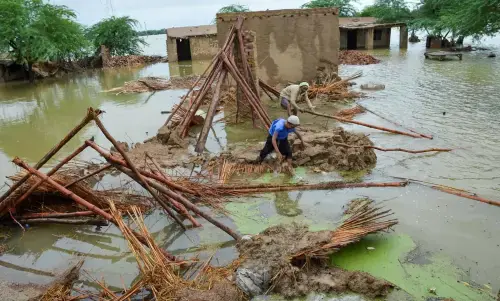
In other situations, increased demand for water due to low rainfall could cause water sources (including boreholes and springs) to run dry. Conversely, heavy rainfall and flooding like recent urban flooding of flood-vulnerable Karachi, Lahore and Rawalpindi cities could damage water sources and sanitation facilities, carry runoff and waste into streams and lakes and contaminate the water supply, the official added.
“Water scarcity through climate change and the consequent increase in the costs of water was prone aggravates further issues of inequitable access to WASH-related public services, making people suffer from various negative health impacts. Because, this situation of water shortages and damages to the WASH infrastructure often deprives households of opportunities to collect the amount of safe water for drinking, meeting sanitation and hygiene needs for proper hand washing, limiting particularly children’s ability to grow up healthy and strong.
Addressing these challenges for making country’s WASH sector climate-proof is a daunting task and calls for well-coordinated and unfailing concerted efforts by all relevant federal and provincial stakeholders as well as those with expertise in the sector.
Identifying climate threats to WASH infrastructure, services and communities is the foremost coping measure.
“However, the ministry has already engaged and coordinating with all stakeholders including Unicef, Wateraid-Pakistan and other non-governmental organisations not only to identify the risks posed to WASH services by climate change but also develop evidence-based solutions to deal with devastating impacts of climate change on the country’s WASH infrastructure facilities so that services regarding water, sanitation and hygiene remain uninterrupted,” Mr Shaikh said.
Quoting from reports of Unicef, the official said around 450 million children lived in areas marked as high or extremely high water vulnerability, where such a huge number of children do not have adequate water to meet their everyday needs for drinking, sanitation and hygiene.
By 2040, almost one in four children would be living in areas of extremely high water stress, he added, quoting the figures from the reports.
“Thus, when disasters hit, they can destroy or contaminate entire water supplies in these high or extremely high water vulnerability areas, aggravating further the risk of the water-borne diseases, mainly diahorrea, cholera and typhoid to which children are particularly vulnerable,” he said.
He said making water supply and sanitation systems that could withstand climate change impacts could save help save lives of millions, particularly women, elderly people and children every year dyeing of various water-borne diseases like diahorrea, cholera, dysentery, typhoid fever, E-coli infection, malaria and dengue.
Talking about various policy implementation measures to address the climate change impacts on water and sanitation infrastructure and facilities, the official said there were solutions being promoted and supported for their implementation in collaboration with provincial and local governments to mitigate climate-related risks to WASH systems. These included reviewing and altering the location or design of a water point or latrine (to make them flood- or cyclone-proof) or technology (deeper boreholes) or promoting renewable energy instead of diesel. Such changes were vital to ensure that the water point or the latrine continues to be functional and accessible for decades even after extreme weather events.
The official said efforts were also being made to priorities climate-related risks based on the assessment and identify technologies and infrastructures to improve climate resilience of the country’s WASH sector.
Published in Dawn, March 4th, 2024