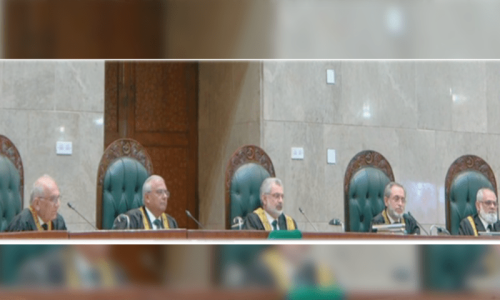
ISLAMABAD: Former ISI chief Lt Gen (retd) Faiz Hamid and Brig Irfan Ramay on Wednesday told the Supreme Court that the Constitution does not provide for continuation of proceedings by the Supreme Judicial Council (SJC) against judges who either resigned from his office or retired on reaching superannuation prior to the conclusion of such proceedings.
In a 23-page concise statement, both the army officers, through their counsel Khawaja Haris Ahmed, contended that any provision of the Constitution which confers upon SJC any power, duty, or obligation to initiate or continue proceedings against a retired judge would not only violative of Article 195 that deals with the retiring age of the high court judge as well as Article 209 (SJC) rather amount to rewriting of the Constitution.
Headed by Chief Justice of Pakistan (CJP) Qazi Faez Isa, a five-judge Supreme Court on Jan 23 had reserved its ruling on an appeal of former outspoken Islamabad High Court (IHC) judge Shaukat Aziz Siddiqui against SJC opinion, as well as Oct 11, 2018 notification under which he was removed as the superior court judge for his July 21, 2018 speech at the District Bar Association Rawalpindi.
In his speech, the former judge had made remarks against the involvement of certain officers of the executive organ of the state, specifically the ISI, in the affairs of the judiciary to allegedly manipulating the formation of the benches of the high court.
Say Article 209 limits SJC powers, excluding post-retirement proceedings
The SJC, in its recommendations, had held that by making a speech at the District Bar Association Rawalpindi on July 21, 2018, Justice Siddiqui had not only violated some express provisions of the code of conduct but had displayed conduct unbecoming of the judge and thus violated the traditional requirements of behaviour expected of the superior court judge.
While closing the hearing, the Supreme Court had also sought opinion from lawyers representing different respondents to ascertain whether SJC had conducted any inquiry before recommending removal of Shaukat Aziz Siddiqui from his office.
If the framers of the Constitution had intended continuation of SJC proceedings even after the retirement of the judges, they would have stipulated the purpose for doing so and also conferred on SJC powers to achieve such objective, the concise statement said.
Article 209 considers the SJC as a domestic forum, limited to exercise powers for the purpose specified. Neither the powers so conferred on the council nor the purpose of which these powers were to be exercised even remotely contemplate the initiation or continuation of proceedings against the judge post his retirement, the statement explained.
The purpose of initiating or continuing proceedings against the judge under Article 209 was to ascertain the professional fitness of the judge. The moment the judge ceases to be a judge, the entire purpose of initiating or continuing proceedings against stands nullified, the statement argued.
If a judge who is facing proceedings under Article 209 retires as contemplated by Article 195, the continuation of proceedings against him in terms of Article 209 would be in violation of the Constitution, the statement asserts.
The statement explained that the petitioner judge was specifically asked to provide evidence in support of his reckless allegation he had made during his address to the District Bar Association Rawalpindi on July 21, 2018. But the petitioner allegedly failed miserably to provide any material and his preliminary reply unequally establishes that he has no such material or evidence with him.
The statement said the SJC proceeded to examine the speech of the petitioner to ascertain whether it amounted to misconduct or not. In a unanimous opinion, the SJC had observed that by making the speech, the petitioner had displayed conduct unbecoming of a judge of a high court and was thus guilty of misconduct.
The statement said the SJC proceeded to examine the speech of the petitioner to ascertain whether it amounted to misconduct or not. In a unanimous opinion, the SJC had observed that by making the speech, the petitioner had displayed conduct unbecoming of a judge of a high court and was thus guilty of misconduct.
The enquiry procedure contemplates that an enquiry in terms of Article 209(5) may or may not entail framing of a charge or recording of evidence. Thus in a case like the one brought before the Supreme Court by the petitioner, where the speech made by the petitioner was admitted, and the SJC was of the considered opinion that very making of the speech amount to misconduct.
Published in Dawn, February 15th, 2024