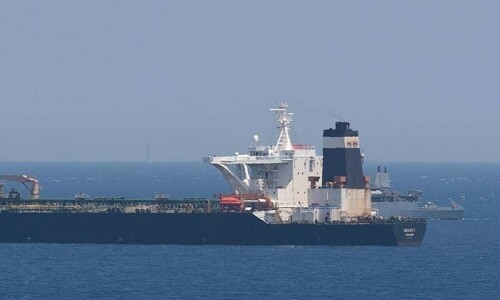
Indian navy frees Iranian fishing boat hijacked off Somalia

India’s navy said on Monday it had freed an Iranian fishing vessel that had been hijacked by pirates off the coast of Somalia in the latest attack against shipping in the Indian Ocean.
The hijacking off Somalia fuelled concerns about a resurgence of Indian Ocean raids by opportunistic pirates, coming on top of a separate surge of attacks launched by Yemen’s Houthi rebels.
“The fishing vessel had been boarded by pirates and the crew taken as hostages,” Indian navy spokesman Commander Vivek Madhwal said, naming the vessel as the Iranian-flagged Iman.
India had deployed its warship INS Sumitra — which was on anti-piracy patrol off the east coast of Somalia in the Gulf of Aden — after receiving a distress message from the fishing vessel.
The warship “intercepted the vessel” and then worked to “coerce” the hijackers to release the crew and boat, Madhwal said, without giving an exact location.
The warship “ensured the successful release of all 17 crew members along with the boat”, he added, with the fishing boat then “sanitised and released for onward transit”.
The navy, which released photographs of the Iranian fishing boat and crew, as well as its sailors towing a skiff, did not give further details of the operation or the fate of the pirates.
Yemen’s Houthi rebels have launched scores of attacks in the Red Sea and Gulf of Aden targeting Israeli-linked vessels in response to Israel’s military offensive against the Palestinian group Hamas in Gaza.
‘Piracy of opportunity’?
International naval forces have been diverted north from the Gulf of Aden into the Red Sea, sparking fears that pirates will exploit the security gap, with the first successful case of Somali piracy since 2017 recorded in December.
Eric Jaslin, the head of France-based Maritime Information Cooperation and Awareness (MICA) Centre, said last month it was still too early to say if attacks were the result of “piracy of opportunity” or because military resources were “focused on the Red Sea”.
Pirate attacks off the Somali coast peaked in 2011 — with the gunmen launching attacks as far as 3,655 kilometres from the Somali coast in the Indian Ocean — before falling off sharply after international navies sent warships and commercial shipping deployed armed guards.
India’s navy has been deployed continuously off Somalia since 2008, but in December sent a far larger force — including three guided-missile destroyers and P-8I reconnaissance aircraft to “maintain a deterrent presence” after a string of shipping attacks.
India, which has close trade ties with Iran, has not joined the US-led maritime task force in the Red Sea to protect international shipping against attacks by Houthi rebels.
On January 5, Indian navy commandos in the Arabian Sea boarded the Liberian-flagged bulk carrier MV Lila Norfolk after a failed hijacking attempt.
On Saturday, suspected Somali pirates boarded and hijacked the Sri Lankan fishing trawler Lorenzo Putha-4 with six crew, about 840 nautical miles (1,555 km) southeast of the Somali capital Mogadishu, the Sri Lankan navy said.
Last month, Somali pirates hijacked the bulk carrier MV Ruen.
The Bulgaria-owned and Malta-flagged vessel was seized by Somali pirates 380 nautical miles east of the Yemeni island of Socotra on December 16.
The pirates, who released one injured sailor into the care of the Indian navy, took the MV Ruen and its remaining 17 crew members to Somalia’s semi-autonomous state of Puntland.