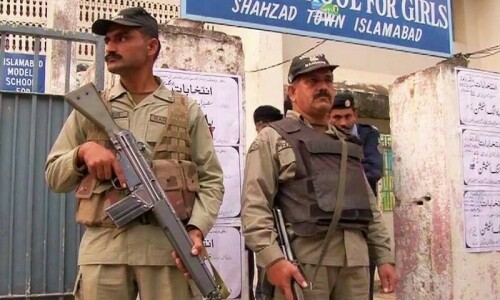
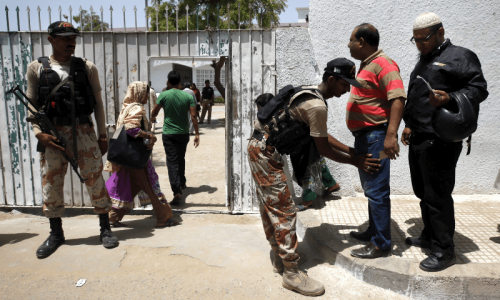
THE state cannot hold elections without the Pakistan Army. On Tuesday, the caretaker government formally approved the deployment of military and civil armed forces personnel at polling stations and sensitive constituencies “in order to maintain peace and security” during the upcoming general elections.
It is understood that these personnel will not only be deputed to guard polling stations on election day but also serve as a rapid reaction force in case any law-and-order situation arises.
The government is said to have approved the arrangement after receiving a summary recommending the same from the hitherto minister-less interior ministry, which cited a severe shortfall of available personnel.
The ECP had previously demanded the services of 275,000 troops from the interior ministry for election-related duties after learning that it was facing a shortage of more than 277,000 security officials, of which about 169,000 were needed in Punjab alone.
It is understandable why the ECP wants boots on the ground for the elections. Apart from various administrative and other reasons, there has been a surge in militant attacks targeting security forces in recent months, and the commission would not want anything untoward happening close to or on election day.
There has also been a recent spate of attacks targeting political leaders, mostly in KP, while there are multiple alerts regarding some politicians facing active threats. It is imperative for the state, in these conditions, to provide a secure environment for politicians and voters in the lead-up to and on election day.
However, the troops being deployed should be clearly instructed that their role is limited to providing security and ensuring peace. They must not, for whatever reason, enter polling stations or interfere in the voting and post-voting procedures. The controversies that arose after the 2018 polls must be avoided at all costs.
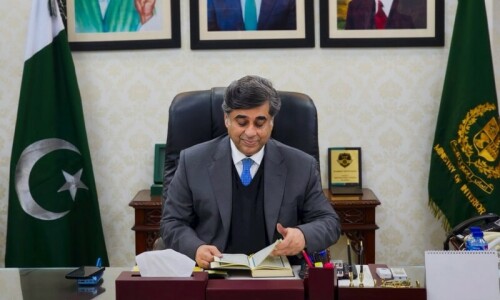
Finally, though Dr Gohar Ejaz was given the additional charge of caretaker interior minister last evening, it is worth asking what took the government so long to nominate him given that Dr Ejaz’s predecessor, Sarfaraz Bugti, had resigned in December.
The government has been quite aware of the deteriorating security situation and has brought it up on various occasions and in different contexts; why, then, had it left the ministry responsible for law and order without a head for more than a month?
This was a rather reckless approach, given the serious challenges that have emerged, with the elections drawing nearer.
Dr Ejaz’s new role will require much attention and energy from him as he tries to address various emergent security-related challenges; will he be able to do so, considering he is also holding several other important portfolios? It is a big ask: the responsibility for the safety of millions now lies with him.
Published in Dawn, January 25th, 2024