KARACHI: The benchmark Karachi Interbank Offered Rate (Kibor) has again started crawling up as chances of a reduction in the key interest rate by the State Bank of Pakistan in its monetary policy review on Jan 29 seem unlikely due to elevated inflationary pressures.
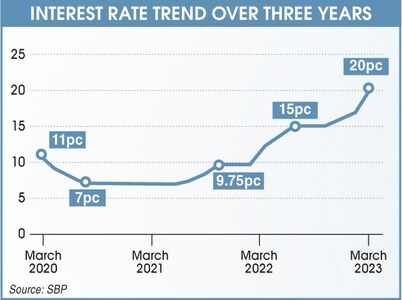
Kibor is a market-determined average interest rate at which banks lend to one another in the interbank market. It has stayed higher during the current fiscal year as its 6-month tenor reached as high as 25pc in September 2023, much higher than the SBP’s policy rate of 22pc.
However, after the central bank’s firm view that inflation would start easing in the second half of 2023-24, the Kibor started declining. However, the annual Consumer Price Index-based inflation kept increasing as it reached 29.23pc in November and further to 29.7pc in December.
“During a week the 6-month Kibor tenor increased by 14 basis points from 20.69 to 20.83pc on Tuesday,” said S.S. Iqbal, a money market expert and dealer. He said there was no hope for a cut in the interest rate and the market started moving in the right direction with higher Kibor.
“I believe there is still space for 20bps for Kibor to go up,” added he.
After completing the first review of the Stand-By Arrangement for Pakistan, the IMF issued a press release on Jan 11 with the observation that inflation remains elevated, although, with appropriately tight policy, this could decline to 18.5pc by the end of June.
Some money market experts said this remark was enough to understand the IMF’s direction for the interest rate despite a 400bps decline in the Kibor.
“Though inflation is coming down but pace of that is slower than expectations. That’s why we don’t think rates will come down in January. Maybe in the next monetary policy review meeting,” said Mohammed Sohil, CEO of Topline Securities Ltd.
The IMF also observed that inflation remains high, affecting particularly the more vulnerable segments, and it is appropriate that the SBP maintains a tight stance to ensure that inflation returns to more moderate levels.
In the treasury bills auction held on Jan 10, the cut-off yields were reduced to 20.99pc for three months and 20.96pc for the 6-month tenors, below the SBP’s policy rate.
Bankers said that the market reactions are the true indications of the future trend of interest rates. They said the government is planning to increase gas prices while the electricity prices are already on a higher path.
“The government’s measures will surely fuel inflation and the SBP would have no chance to reduce the interest rate,” said a senior banker.
He said the Kibor would go higher since the hopes for a rate cut have shifted to March.
Published in Dawn, January 24th, 2024