0
0

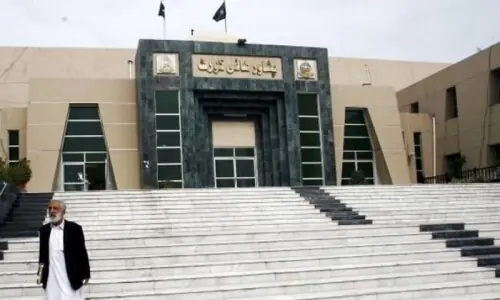
PESHAWAR: Declaring that the caretaker provincial government has no mandate to take major policy decisions, Peshawar High Court has stopped it from proceeding further on its decision to establish two medical universities in the province.
A bench consisting of Justice Syed Mohammad Attique Shah and Justice Syed Arshad Ali has ordered: “Any hasty decision of the caretaker government does not seem appropriate at this stage, therefore, the caretaker government shall not further proceed in the matter and will obviously leave final decision to elected government.”
The bench states that it would be in the public interest that the establishment of two universities be deferred to the decision of a newly-elected government more particularly when the elections have to take place on February 8, 2024.
Referring to different provisions of KP Universities Act, 2012, Elections Act, 2017, and judgments of superior courts, the bench ruled: “As stated above, establishment of educational or medical university in this part of the province is indeed a very noble cause. However, it is for the elected government to decide and take a policy decision for the establishment of any university.”
Bench directs them to leave the matter to elected govt
The bench maintained that the caretaker government had a very limited mandate in terms of Section 230 of Elections Act.
The bench issued the order over a petition filed by Khyber Medical University Employees Welfare Association through its president Dr Brekhna Jamil, challenging the announcement made by the caretaker prime minister, Anwaarul Haq Kakar on December 20, 2023, and subsequent decision taken by the caretaker provincial government to set up two new public sector medical universities by upgrading Khyber Medical College (KMC), Peshawar, and Ayub Medical College (AMC), Abbottabad.
The petitioner’s counsel Babar Khan Yousafzai requested the court to set aside the impugned directives of the caretaker prime minister and decision of the provincial government in that regard.
The bench observed that the apex court in one of its judgments ruled that caretaker government had no mandate to take policy decision and permanent measures including recruitments, making appointments, transfer and posting of government servants.
It must leave such matters to elected government, which took charge as a result of elections, it added.
“Therefore, there can be no two opinions that the role of the caretaker government is very limited and it has no jurisdiction to undertake any new project, which may have financial implications on the consolidated funds or would embarrass the elected government to reverse the said decision, if in the opinion of elected government, it has either no financial means to implement the decision or it does not feel that the said policy decision is administratively workable,” the bench observed.
The bench adjourned the hearing, directing the relevant office to fix it for hearing in the month of March, when after the elections, an elected government would be formed.
The KP advocate general, Aamir Javed, contended that the petition had been filed at a very premature stage as Election Commission of Pakistan had yet to grant an approval pursuant to the decision of the caretaker provincial cabinet.
Babar Yousafzai said that the decision was taken in haste as caretaker government neither consulted Higher Education Commission (HEC) nor the boards of governors (BOGs) of Medial Teaching Institution (MTI) Khyber Teaching Hospital and Ayub Teaching Hospital of which KMC and AMC, respectively, were the constituent colleges.
He said that HEC was unable to enhance its budgetary support to public sector universities. He added that at present majority of the 34 public sector universities in the province were already in severe financial crisis.
KMU former dean Prof Noorul Iman, who voluntarily appeared in the case, stated that KMC had the financial capacity to bear all the expenses of a newly-established university. He said that KMC was one of the oldest medical colleges and was being managed and run by highly qualified faculty.
Published in Dawn, January 24th, 2024