0
0

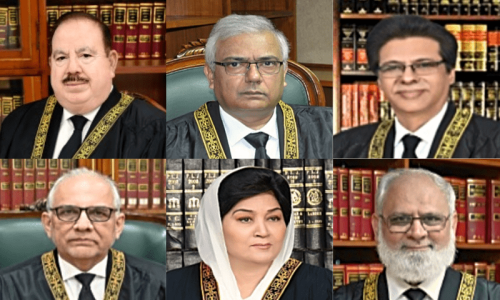
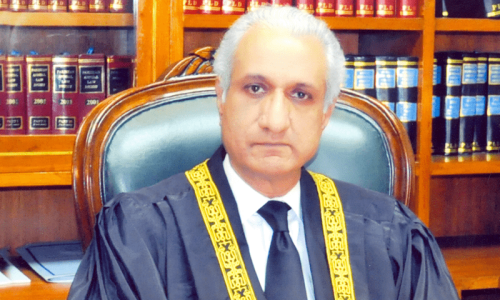
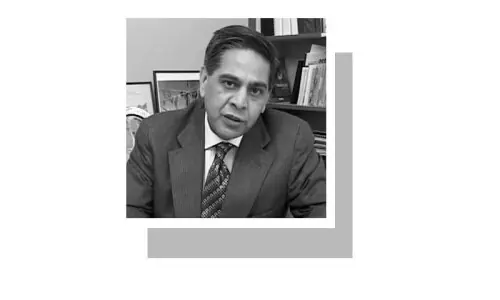
ISLAMABAD: Former chief justice of Pakistan and one of the petitioners, Jawwad S. Khawaja, on Thursday moved an application before the Supreme Court, seeking the reconstitution of a larger bench consisting of the seven senior-most judges to decide the intra-court appeals (ICA) in the military court case.
Moved through his counsel Khawaja Ahmad Hosain, the application prayed that the Supreme Court should declare that the present six-judge bench headed by Justice Sardar Tariq Masood was not constituted by the three-judge committee, which was set up under Section 2 of the Supreme Court (Practice and Procedure) Act 2023.
The application has sought a declaration from the Supreme Court that the present benchhearing ICAs was not a lawful larger bench under Section 5 of the Act since it comprises a judge who has previously heard the original petition.
Headed by Justice Sardar Tariq Masood, the bench by a majority of five to one had suspended on Dec 13, 2023, the Oct 23 short order of declaring as unconstitutional the trial of 103 civilians identified in relation to their alleged involvement in the May 9 violence.
Questions legality of six-judge bench led by Justice Masood
The applicant pleaded that pending ICAs should be referred back to the three-judge committee for the implementation of its earlier decision to constitute a bench consisting of seven senior-most eligible judges to hear these appeals.
The application explained that Justice Masood was part of the original bench and had given a finding that every individual case has to be considered on the basis of the facts of the case. In giving this finding, Justice Masood had decided that the subject petitions brought in the public interest by parties who were not accused under the Pakistan Army Act (PA) 1952 were not maintainable under Article 184(3) of the Constitution.
Justice Rizvi also stated that the very purpose of an appeal is an entire re-hearing by a new set of judges, and it would defeat the purpose of providing an appeal if a judge who has sat on the original bench and even expressed a view was made part of the appellate bench.
It is a settled principle of law that for appellate right to be meaningful, no judge who has decided an issue in the original case may sit as part of any appellate forum, the application said, adding this principle was in line with Article 14(1) of the International Covenant on Civil and Political Rights (ICCPR), which provides everyone should be entitled to a fair and public hearing by a competent independent, and impartial tribunal established by law.
Pakistan is a signatory to ICCPR, the application said, adding that on Dec 11, 2023, the now retired Justice Ijazul Ahsan had written a letter to the secretary to the committee, stating the seven-bench consisting of judges in order of seniority should hear ICA. Consequently, the applicant also wrote a letter to the secretary on Dec 28, 2023, with a request to ensure compliance of what Justice Ahsan had stated.
Published in Dawn, January 19th, 2024