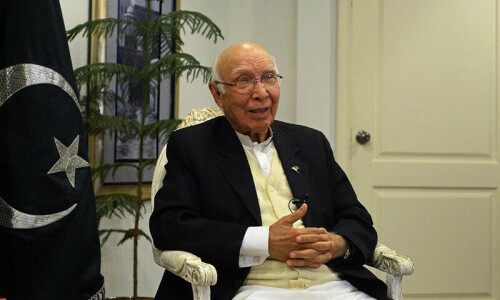
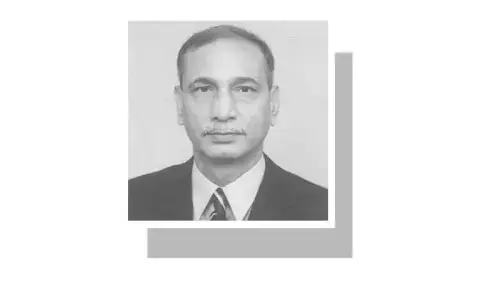
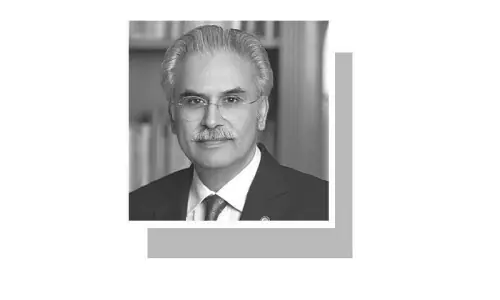
The passing of Sartaj Aziz, a former foreign and finance minister, represents a profound loss in the country’s political history. His extensive career spanned several decades in which he significantly contributed to the country’s political, economic, and external relations domains, as well as its internal security.
Born on Feb 7, 1929, in the Nowshera district, Aziz was a prominent figure in Pakistan’s political landscape. His academic achievements laid a strong foundation for his future roles; he held a master’s degree in Economics from Punjab University and another in Development Economics from Harvard University.
He was twice elected as a senator on the PML-N’s ticket in the 1980s and early 1990s. Aziz served as finance minister during the 1990s cabinet of then prime minister Nawaz Sharif. Later, he held the position of adviser for foreign affairs and national security.
His tenure as finance minister, especially during his second stint, was pivotal, characterised by economic reforms and policies aimed at stabilising and growing Pakistan’s economy. These included tax reforms, fiscal discipline, privatisation of state-owned enterprises, and economic liberalisation, all designed to alleviate the fiscal burden on the government and attract foreign investment. His policies also focused on developing infrastructure and social sectors.
Despite facing challenges such as controlling inflation and criticism over the social impact of his policies, Aziz’s tenure as finance minister was a period of significant economic transformation, leaving a lasting impact on the country’s fiscal landscape.
A defining moment in Aziz’s career was his opposition to the nuclear tests due to concerns over potential economic sanctions and isolation. His stance contrasted with that of Foreign Minister Gohar Ayub Khan and others in the foreign policy establishment who advocated for the tests. Aziz argued for a comprehensive security umbrella, prioritising Pakistan’s long-term stability and security.
As foreign minister, Aziz played a key role in navigating Pakistan’s foreign policy during a challenging period, serving from Aug 7, 1998, to Oct 12, 1999, and later as an adviser on foreign policy and national security from June 7, 2013, to July 28, 2017.
His first tenure began in the aftermath of nuclear tests, succeeding Gohar Ayub, who resigned over policy differences with Nawaz Sharif. Aziz was chosen for his diplomatic approach towards India and handling international pressures. Moreover, he was seen as someone who was amenable and could work with everyone — the civilian leaders as well as military.
In 1997, Aziz aspired to become the presidential candidate for PML-N after Farooq Leghari’s resignation but did not secure the nomination.
His exclusion was attributed to his outsider status within Nawaz Sharif’s inner circle, despite being a senior party leader.
In his second stint at Foreign Office, he served as an adviser on foreign policy and as national security adviser between 2013 and 2015. His tenure was marked by a focus on economic diplomacy and addressing security challenges, including counterterrorism strategies and regional cooperation.
Aziz was not appointed as foreign minister due to not being a member of the parliament. In the 2015 Senate elections, he was denied a party ticket, reportedly due to his critical views of Nawaz Sharif expressed in his book “Between Dreams and Realities”.
He chaired the Fata Reforms Committee, proposing transformative changes for the tribal area, and led a commission on Gilgit-Baltistan, recommending “provisional provincial” status to provide constitutional rights to its people without affecting Pakistan’s position on the Kashmir dispute.
His approach to foreign policy skillfully balanced national security concerns with economic objectives. As the national security adviser, he initiated work on the national security policy and established the secretariat of the national security division.
Beyond his governmental roles, Aziz contributed to academia as vice chancellor of Beaconhouse National University.
In recent times, after the passing of his wife in December 2021, he led a solitary life. In our last conversation, his frail health permitted only a brief exchange, during which he requested prayers.
Published in Dawn, January 4th, 2024