0
0

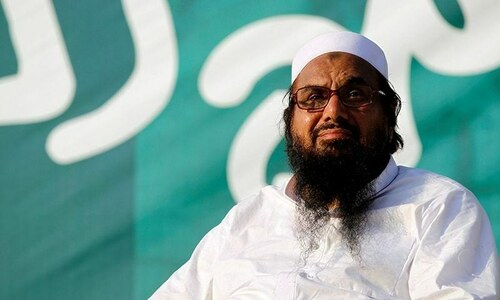
ISLAMABAD: The Foreign Office on Friday officially declined India’s demand for the extradition of Jamaatud Dawa (JuD) chief Hafiz Saeed after New Delhi announced it had formally requested Islamabad to extradite him in a money laundering case.
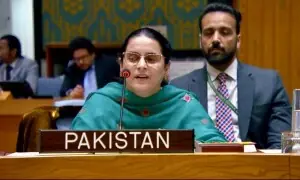
Responding to media inquiries about India’s extradition request, Foreign Office spokesperson Mumtaz Zahra Baloch pointed out that “no bilateral extradition treaty exists between Pakistan and India”.
Saeed is currently serving a jail sentence after being convicted of terror financing in multiple cases. He has received various prison sentences, ranging from over 15 to 31 years.
Although India accuses him of being behind the 2008 Mumbai attacks, Saeed has denied any involvement.
He was arrested in 2019 when Pakistan was struggling to get out of the Financial Action Task Force’s grey list comprising countries with strategic deficiencies in their anti-money laundering (AML), counter-terrorism financing (CFT), and proliferation financing regimes.
FO says no extradition treaty exists between both countries; New Delhi’s request follows Chinese reprimand over ‘double standards’ on terrorism
In 2012, the United States announced a $10 million bounty on Saeed. Both the Lashkar-e-Taiba and JuD are banned entities in the US and under UN sanctions.
Earlier on Friday, Arindam Bagchi, the spokesperson for India’s External Affairs Ministry, emphasised at a media briefing in New Delhi that the extradition request, delivered last week via the Indian high commission in Islamabad, was accompanied by relevant documentation.
However, he acknowledged that the request for Saeed’s transfer to India to stand trial was made despite the lack of an extradition treaty with Islamabad.
‘Chinese reprimand’
India’s revelation of the request followed a Chinese reprimand, on Wednesday, of New Delhi’s “double standards” in dealing with terrorism.
It was referring to Pakistani reports of a Baloch rebel’s surrender and his naming of India as the sponsor of the group’s activities.
Chinese Foreign Ministry spokeswoman Mao Ning said such a posture “benefits no one” and comes at the “expense of international and regional security and will only backfire”.
Reports said Mao’s comments came in response to claims by a former Pakistani militant commander, Sarfraz Bangulzai, of the banned militant organisation Baloch National Army, according to a transcript of a news conference released by the ministry.
She told reporters in Beijing: “To support and use terrorist groups and let them thrive out of one’s selfish interests at the expense of international and regional security benefits no one and will only backfire.”
“China stands for strengthening counterterrorism cooperation among all countries to jointly fight all forms of terrorism,” stressed Mao.
She was responding to a question by the China Daily newspaper that India “has been secretly supporting terrorist activities in Balochistan and financing Balochistan separatist forces” as alleged by Bangulzai.
“China firmly opposes double standards on counterterrorism. To support and use terrorist groups benefits no one and will only backfire,” the ministry posted on X with a link to a media report with allegations by Bangulzai.
The announcement was made at a press conference in Quetta, with provincial Information Minister Jan Achakzai also in attendance.
Our correspondent in New Delhi also contributed to this report
Published in Dawn, December 30th, 2023