0
0

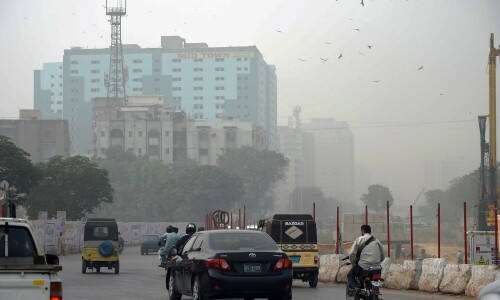
PESHAWAR: Setting alarm bells ringing for residents, the capital of Khyber Pakhtunkhwa province recorded very unhealthy air for five consecutive days this week with the air quality being even worse than Lahore’s on three days, reveals a Swiss air quality technology company on its website.
The data posted on IQAir’s website is sourced from at least 10 air quality monitors installed by the Bank of Khyber, Peshawar Clean Air Alliance, and the US Consulate.
The data shows thaton Dec 8,Peshawar’s air quality index (AQI) recorded 247 with the air being categorised as very unhealthy. The same day, Lahore’s AQI was 233.
Peshawar and Lahore’s AQIs were 214 and 236 respectively on Dec 4, 224 and 206 on Dec 6 and 255 and 226 on Dec 5.
CM calls meeting on pollution on Tuesday
However, Peshawar didn’t appear in the list of the world’s most polluted cities, including Lahore.
Karachi, too, keeps popping up among such cities.
Climate policy specialist Dawar Butt told Dawn that the major reasons for Peshawar not being on the most polluted cities radar were that the capital city had a few air quality monitors and that it had a small population compared to mega cities like Lahore and Karachi.
“If Karachi’s AQI is even about 200, it will appear on the most polluted cities list but Peshawar won’t despite scoring even higher,” he said.
Dr Khan Alam, a professor at the University of Peshawar, who holds a doctorate in atmospheric physics, told Dawn that the measurements they took were even higher compared to readings by the US Consulate.
He said in winters, pollutants were mostly dispersed from 500 meters to one kilometres height, so due to the dense air, pollutants could disperse to higher altitudes as they did in summers.
“In summers, pollutants disperse up to altitude to three to four kilometres and therefore, we do not see much pollution in summers,” he said.
The professor also said that winters were usually dry and even the air was calmer making the “pollution crisis even worse.”
He said that Peshawar was a valley with mountains surrounding it, which also led to the accumulation of the pollutants.
Dr Alam saideven if Peshawar was located at a higher altitude, pollution would not have been so severe.
He said industrial and vehicular emissions and those from biomass burning were some of the main reasons for pollution in the capital city.
“An old school bus on city roads produces more pollution than scores of modern vehicles,” he said.
Anwar Khan, director-general of the Environmental Protection Agency KP, acknowledged that Peshawar suffered from poor air quality.
He, however, said the data of air quality monitors was on the “higher side.”
“We want to calibrate each of these monitors against lab certified monitors,” he said.
Mr Khan said one of the air quality monitors installed in the Dalazak Road area was showing the AQI of 387 but a departmental check put it at 187 only.
He said those air quality monitors were good in terms of raising awareness of pollution.
The official said the department did not have its own pollution monitoring system and the one donated by the Japan International Cooperation Agency was out of order.
He also said the department had also planned to install an air quality monitoring system in the provincial capital at the cost of over Rs70 million, which was also reflected in the province’s annual development programme.
“We [EPA] have also asked the commissioner of Peshawar Division to take several steps in order to control air pollution in the capital city. Also, the caretaker chief minister has called a meeting on it next Tuesday,” he said.
Published in Dawn, December 10th, 2023