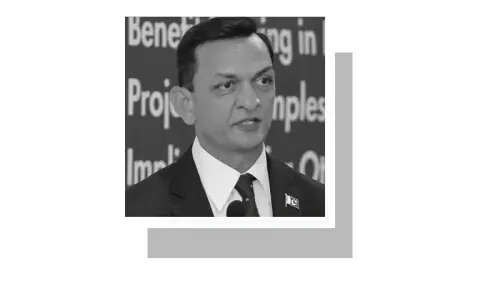
KARACHI: State Bank of Pakistan (SBP) Executive Director for Digital Financial Services Group Syed Sohail Javaad said on Tuesday the country’s instant payment system Raast is on a par with similar systems implemented by developed and developing countries around the world.
“You have to think of the possibilities. The SBP has provided you with all the tools that are being used globally, (especially) in India and China,” he said while addressing Retail Show 2023 organised by TerraBiz.
Mr Javaad said people are increasingly shifting from cash to mobile banking, with the annual value transacted via mobile channels doubling every year.
The number of mobile banking transactions increased in 2022-23 to 660.6 million while the amount clocked in at Rs23.8 trillion. This translates to an annual year-on-year growth of 70.5 per cent in volume and 100.5pc in value.
The SBP official said global examples show shifting from cash to digital modes typically leads to an increase of seven to eight times in payments. “Businesses should adopt digitisation to increase sales,” he said, noting that Raast is preferred by the young, tech-savvy people who form the bulk of the country’s population.
The instant payment system that was rolled out only a couple of years ago already boast of 34 million unique IDs, equal to the total number of debit cards issued by all commercial and microfinance banks.
As many as 1.3m person-to-person (P2P) transactions take place on Raast every day while the average daily value is Rs28 billion.
Mr Javaad also announced the formal rollout of the SBP’s person-to-merchant (P2M) online payment system within Raast on Tuesday. The P2M system will enable merchants and small businesses to receive payments from their customers in real-time.
Talking about the features of P2M, he said merchants will have aliases on Raast just like users have handles on X, formerly known as Twitter. Furthermore, businesses will have the option to have aliases with separate till codes for each checkout till used by different tellers.
The P2M system will let merchants use Raast QR codes that can be either static or dynamic. A merchant can print and display a static QR code on their shop’s countertop. The customer will open the Raast option in their banking app, scan that code, insert the rupee amount and make the payment in no time.
However, a dynamic QR code will also include the amount and will be generated by the merchant separately for every customer. In this case, the customer will just have to scan the code and hit ‘pay’.
Yet another feature under the new P2M system is called request to pay. This will come in handy while paying one’s electricity bill, school fee or municipality taxes. “Every invoice or challan is a request to pay. Now anyone can initiate a request to pay in Raast. All that a customer will need to do is open their app and respond yes to that request to pay,” he said.
For example, e-commerce merchants can simply print a QR code and stick it on top of their delivery package. The P2M system will allow the customer to scan the code and pay at the time of accepting the delivery, he said.
Published in Dawn, December 6th, 2023