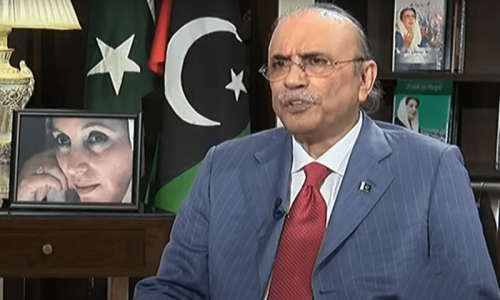
OFTEN described as an accidental leader, Asif Ali Zardari is undoubtedly one of the shrewdest political figures in the country. Past master in the art of political wheeling and dealing, he has managed to maintain the party’s role as a major player in the power game, despite its eroding national status. But his politics of gamesmanship has also caused the party to lose direct contact with the masses, which was the hallmark of PPP politics since the party’s inception.
Now it seems that his leadership and style of politics is being challenged by his son. But the crafty politician is not willing to give up his mantle.
In a long TV interview last week, Zardari struck back with a clear message that he is still the boss. Curiously, cracks have emerged with the elections only a couple of months away.
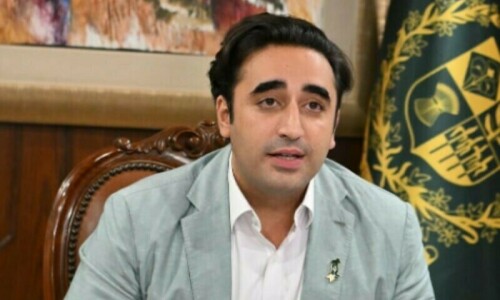
What seems to have irked the former president was Bilawal Bhutto-Zardari’s public statement calling old politicians — that also includes his father — to retire and clear the way for the younger generation. “Stopping someone will only create more problems,” Zardari retorted.
But it was certainly not the only reason behind the widening gap between the two. Bilawal’s increasing assertiveness and aggressive stance against the PML-N on various issues at public rallies also seem to have led Zardari to criticise his son publicly.
“Bilawal is also not fully trained,” he remarked, “[We] are training him.”
Although there have been reports of differences between father and son on various issues related to policy matters, it was for the first time that Zardari publicly rebuked his son. In his interview, he forcefully justified his own approach.
Most importantly, he sounded quite confident of his party heading a coalition government after the elections. His statement cannot be dismissed as mere boastfulness; he seems to actually believe that his political manoeuvring can work.
In spite of his political deal-making skills, Zardari has never had the Bhuttos’ popular appeal.
For Zardari, it seems Bilawal’s harsh tenor towards rival political parties could harm the party’s prospects of power. The gap seems to be increasing as the two have taken contradictory positions on the fairness of the electoral process.
Such division on the narrative in the run-up to the polls could hugely damage the party’s electoral prospects. It seems the divide can intensify with the allocation of party tickets as Zardari has indicated that tickets would be given at his discretion.
It is not just about who calls the shots in party matters. The differences also reflect the long-brewing frustration in the ranks as the party loses its support base particularly in Punjab, limiting its presence to Sindh.
There seems to be a strong feeling that its existing approach limits its entire politics to deal-making, and the PPP could lose further ground in the coming national polls. It will also be a struggle to return to populist politics to regain lost political ground particularly in Punjab.
The transformation from populist politics to the old-style wheeling and dealing came after Zardari took charge following the assassination of Benazir Bhutto. That also brought an end to the party’s strong connection with the masses.
His excellent political deal-making skills aside, Zardari never had the kind of popular appeal the Bhuttos had. Therefore, it’s not surprising that the PPP has turned into a regional party under his leadership. The party returned to power after the 2008 elections that took place months after Benazir Bhutto’s assassination, but the slide in its political fortunes started appearing soon after.
It may be true that Zardari’s skill at making compromises helped the party survive in power for afull five-year term, an unprecedented feat in Pakistan’s political history. But electoral support for it suffered during that period because of the absence of a popular leadership.
The government’s poor performance led to the party’s fall in the 2013 elections. The party succeeded in retaining power in its stronghold of Sindh, but was almost wiped out in Punjab except for a few seats won in the south of the province.
With the emergence of the PTI as the main challenger to the PML-N, the PPP lost further ground in the province. Several of its leaders joined the PTI bandwagon. The party’s once strong vote bank disappeared. As a result, the PPP could win only six seats in the Punjab provincial assembly in the 2018 elections.
The PPP, however. remained a significant player on the national political stage because of its continued political domination in Sindh. It may also be true that Zardari played an important role in the vote of no confidence against Imran Khan. Although Zardari fully backed the PDM-led coalition government, which included Bilawal as foreign minister, the PPP refrained from taking responsibility for the Shehbaz Sharif administration’s flawed economic policies.
Apparently, one of the reasons for its decision to take the foreign ministry was to build Bilawal’s political profile and prepare him for the top job. But in the emerging political landscape, where the PTI remains a major political force despite the crackdown against it, there is little possibility of the PPP regaining its lost space in Punjab.
Meanwhile, Zardari’s gamesmanship received yet another jolt when the Balochistan Awami Party ditched the PPP to join the PML-N, which is perceived to have the backing of the security establishment. The PPP was confident of forming the government in the province, which would have given the party greater clout in the formation of the future government.
Bilawal, who has remained under the shadow of his father despite his increasing political profile, now seems to have realised the limits of the party’s existing approach as elections draw near. But his desire to change direction and go back to mass politics with a clear programme seems to have come too late in the day.
It is the hour of reckoning for a party that has dominated Pakistan’s political scene for decades. One of the most powerful national parties is now struggling to keep itself politically relevant.
The writer is an author and journalist.
zhussain100@yahoo.com
X: @hidhussain
Published in Dawn, November 29th, 2023