AMIDST the tragic events in the Middle East, it is crucial to learn from history and foresee potential outcomes for a saner, wiser future. Taking a glance back in time, we find a striking parallel in the Bronze Age, an era of magnificent civilisations thriving more than 4,500 years ago in the Levant, which is the region now known as the Middle East.
It was a period of human evolution where stone tools gave way to metal implements, marking progress in mastering metals. The Levant during this era was a hub of cultures, with Egyptians, Babylonians (current Iraq), Minoans, Mycenaeans and Hittites (current Turkiye), building up economic networks and making agricultural advancements. This period is often hailed as the first ‘globalised economy’ due to the extensive trade relations in key metals between the kingdoms.
However, the grandeur of the Bronze Age that had taken centuries to evolve was obliterated within a single generation. A series of disasters, including mega-droughts spurred by climate change and devastating wars, resulted in agricultural losses, wide- spread famine and diseases.
Internal strife as well as weakened kingdoms had made the Levant vulnerable, opening the door for the infamous ‘Sea People’. These marauders arrived on multiple ships, attacking numerous kingdoms, disrupting cultures, demolishing economies, and dragging down massive empires.
This catastrophe, aptly termed the ‘Bronze Age Collapse’, cast the region into a Dark Age that endured for centuries, setting civilisations back to a state of mere survival. Professor of Classical Studies Dr Robert Drews described the collapse as “arguably the worst disaster in ancient history, even more calamitous than the collapse of the Western Roman Empire.”
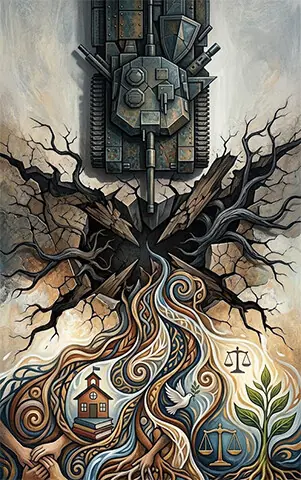
Fast forward to 2023, and we witness multiple nations in the Middle East standing at a critical juncture once again. To comprehend the complexities of the present, we must have a sense of history. In the power struggle that we see today, the United States, akin to the ancient ‘Sea People’, is the external factor that is bound to drag everything and everyone down.
What we never did in ancient history was to show empathy beyond self-interest, allowing the ‘Sea People’ to destroy everything. Let us all learn this crucial lesson, and embrace dialogue to steer away from the perilous route of destruction.
By doing so, we can at least try to build a future grounded in tolerance, if not unity.
Adil Hanif
London, UK
Published in Dawn, November 17th, 2023