Doctor in Gaza finds his own relatives dead



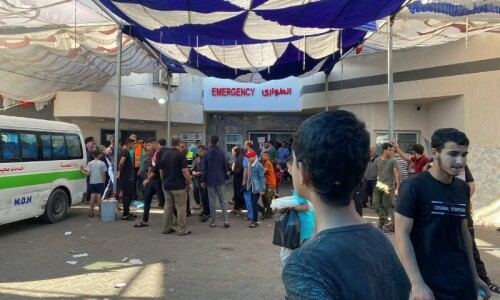
GAZA CITY: Iyad Shaqura, a doctor of pharmacy turned by the Gaza crisis into an emergency physician, had become used to the flow of dead and wounded streaming into the hospital in Khan Yunis.
But on Monday evening, he fainted when he saw the bodies of his two sons, his mother and his two brothers arrive at the emergency room.
His family had been killed by a strike that hit their home in Khan Yunis, in the south of Gaza Strip.
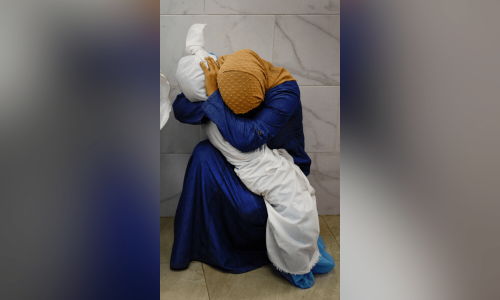
On Tuesday morning, his eyes filling with tears, Shaqura took a last look at his loved ones, draped in white shrouds and placed on the mortuary tables in the emergency room of Nasser Hospital.
Pointing at the bodies, one after the other, he listed their names: “My mother, Zeinab Abu Dayya, my brothers Mahmud and Hussein Shaqura, my sister Israa and her two children Nabil and Nur, and my two children, the apple of my eye, Abdelrahman, seven, and Omar, five.
“I have five children, but he was my favourite,” said Shaqura, resting his forehead on Abdelrahman’s.
His shroud and that of his brother were open at the face.
“What did they do to have tonnes of bombs and explosives dropped on their heads in their home?” he said, before adding with resignation “God called them back to him like many other children before them”.
`Triumph or be buried’
Shaqura is from a family of Palestinian refugees displaced from their land during the creation of Israel in 1948.
Such refugees and their descendants account for about 80 per cent of the 2.4 million people living in Gaza Strip.
“If the enemy wants to hunt us again, we will tell them that God has promised us one of two things: either to triumph in our liberated lands or to be buried there,” said Shaqura, adding: “Now I will bury my children and return to work.”
He then led the funeral prayer in the hospital courtyard, while his colleagues and relatives stood upright behind him. The bodies of his family were laid out on stretchers before him.
Their bodies were then taken to a graveyard nearby.
Shaqura carried in his arms Abdelrahman, whom he kissed one last time on the head.
Published in Dawn, November 8th, 2023