• Headed by CJP Isa, five-judge bench to take up intra-court appeals on 31st
• In a majority judgement, apex court on Sept 15 declared amendments to NAO by PDM govt illegal
• Govt terms ruling contrary to principles of ‘natural justice’
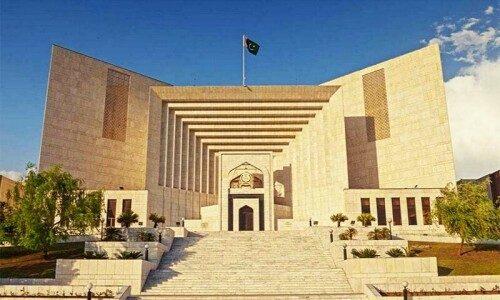
ISLAMABAD: The Supreme Court will take up on Tuesday the first-ever intra-court appeals (ICAs) against its Sept 15 majority judgement that declared amendments to the National Accountability Ordinance (NAO) as illegal.
A five-judge SC bench will take up the ICAs in line with its Oct 11 short order in which the PDM government-made law to regulate the affairs of the top court — namely the Supreme Court (Practice and Procedure) Act 2023 — was upheld.
On Oct 26, the Supreme Court had also issued a circular for the information of all concerned that any appeal filed in the top court against the decisions taken on petitions moved under Article 184(3) of the Constitution should be moved in the form of ICA.
The circular issued by the registrar office explained that “Section 5 of the Supreme Court (Practice and Procedure) Act 2023 provides that an appeal will lie before this court against an order passed by this court while exercising jurisdiction under Article 184(3) of the Constitution”.
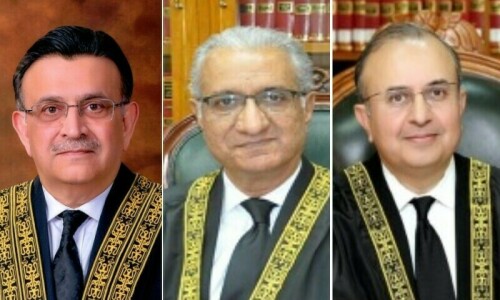
The larger bench headed by Chief Justice of Pakistan (CJP) Qazi Faez Isa and comprising Justice Amin-ud-Din Khan, Justice Jamal Khan Mandokhail, Justice Athar Minallah and Justice Syed Hasan Azhar Rizvi will take up two ICAs — one filed by the federal government and the other by former SSGCL managing director Zuhair Ahmed Siddiqui.
The federal government in its appeal had requested the apex court to set aside the Sept 15 majority judgement that had declared amendments to the NAO illegal.
Moved through senior counsel Makhdoom Ali Khan, the government had taken the plea that the majority judgement was opposed to the facts of the case and contrary to the law.
On Sept 15, the Supreme Court by a majority of two-to-one had ruled that the public representatives who benefited from the amendments made by the PDM government in the National Accountability Ordinance will have to face corruption references again.
Through the ICA, the federal government argued that PTI Chairman Imran Khan, who had challenged the amendments, was given opportunities during the hearing not only to make verbal submissions for 27 hearings but also to make submissions in rebuttal, whereas the federation was restricted only to answering queries from the bench.
Similarly, the ICA said the respondent (Mr Khan) was allowed three months’ time to file his written submissions, but the federation’s request for grant of the same time or at least three weeks had not been entertained. Having left with no other option, the written submissions were hurriedly prepared and filed by the federation on Sept 12, as yet another government’s request seeking postponement of the case or constitution of a full court bench for hearing the petition in view of the SC (Practice and Procedure) Act, 2023 was also not decided. Thus, the majority judgement is contrary to the principles of natural justice and due process of law and against the dicta law laid down by the SC larger bench in the 1990 Amanullah Khan case, it added.
The ICA emphasised that a number of references were returned or transferred to other fora under the amendment act and as per the information provided by NAB, no acquittals were ordered under the amendment act.
On the contrary, a number of acquittals were ordered pursuant to the amendment ordinances promulgated during the PTI government and in some cases NAB had gone in appeal and in others the accused had done so.
Majority of the appeals and petitions are pending before high court but none of the accused, whose references were returned or transferred pending to other fora or appeals, were parties before the SC and the facts of their cases were not before the top court, the ICA contended.
Published in Dawn, October 29th, 2023