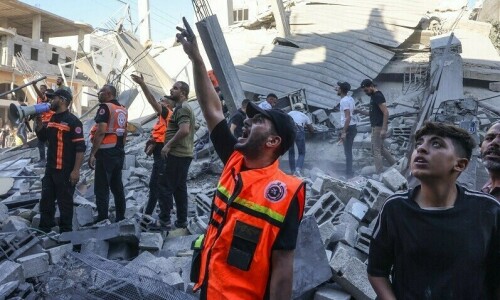
Previous tolls given by Gaza ministry termed ‘credible’

JERUSALEM: The UN agency for Palestinian refugees said on Friday the death toll given by the health ministry in Gaza had proved to be “credible”, referring to a US statement that raised doubts about figures given by the Palestinian groupo.
“In the past, the five, six cycles of conflict in Gaza Strip, these figures were considered as credible and no one ever really challenged these figures,” UNRWA chief Philippe Lazzarini told reporters in Jerusalem.
The fatalities in Gaza are the highest since Israel withdrew from the Palestinian territory in 2005.
Lazzarini said 57 UNRWA staff had been killed since Oct 7, explaining how the agency’s toll reflected the broader casualty rate in Gaza.
He suggested the ratio of UNRWA staff killed to the total number of agency workers was in line with the ratio of Gazans killed to the territory’s overall population, as provided by the health ministry.
“We have more or less the same percentage,” he told journalists in Jerusalem.
Ministry names victims
Lazzarini’s comments came just days after US President Joe Biden said he had “no confidence” in the figures provided by Hamas. “I have no notion that the Palestinians are telling the truth about how many people are killed. I’m sure innocents have been killed, and it’s the price of waging a war,” he told a White House press conference on Wednesday.
A day later, the health ministry responded by releasing the names, identity card numbers, gender and age of almost 7,000 of those killed in Gaza.
“We have decided to announce the details of the names to the whole world so that the truth is known about the genocide perpetrated by the Israeli occupation against our people,” the ministry said.
In an explanatory note accompanying the list, health officials said they have a digital database of the people killed. When it comes to each governmental hospital, “personal information and identity numbers” are added to the computer system for each body or each patient who succumbs to their wounds.
These figures are transmitted daily from the governmental hospitals to the health ministry’s central registry, the document said. Healthcare workers at privately-run hospitals meanwhile record deaths on special forms which are sent within 24 hours to the health ministry.
A service within the ministry is tasked with “ensuring that they (data) do not contain duplicates or errors” before adding the information to their central database.
Published in Dawn, October 28th, 2023