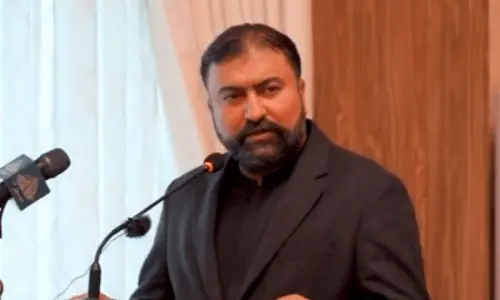
KARACHI: Sindh Minister for Revenue and Industry Muhammad Younus Dagha wore the hat of an energy expert on Tuesday to fend off piercing questions from angry environmentalists on the growing use of Thar coal.
Speaking at a dialogue on the energy sector reforms organised by The Knowledge Forum, he said the country must prioritise affordability over sustainability when opting for an optimal energy mix. “Europe, China and the United States increased their coal dependence last year after the Ukraine war,” he said.
Although Mr Dagha served in multiple senior positions before retirement from civil service, he’s best known for his stint as federal secretary for water and power between 2014 and 2017.
According to the 10-year Indicative Generation Capacity Expansion Plan (IGCEP), furnace oil will be phased out by 2031. Meanwhile, the plan envisages a gradual move away from fossil fuels and towards renewable as well as indigenous sources like Thar coal.
Mr Dagha said growing economies like India and China are burning coal to generate as much as 70 per cent and 45pc of their total electricity. “Our global carbon footprint is miniscule in comparison,” he said.
The share of local and imported coal in the electricity generation mix was 10.3pc and 4.5pc, respectively, in August, which is the latest month for which official data is available. The cumulative share of coal in the energy mix in August makes it the third biggest source of electricity after hydel (37.6pc) and imported gas (17.2pc). Other major contributors to the energy mix were nuclear (12.8pc), local gas (7.6pc), wind (5pc), furnace oil (4.1pc) and solar (0.5pc) in August.
The IGCEP says Pakistan should produce 60pc of electricity through non-fossil fuels by 2030. According to Mr Dagha, the country should maximise the share of Thar coal within the rest of 40pc component that’ll still be based on fossil fuels. “We should go for Thar coal more aggressively,” he said.
A climate change activist asked the provincial minister to look at chimney-like urban centres and polluted rivers instead of citing global data on carbon emissions to downplay Pakistan’s contribution to pollution.
“By this logic, the entire industry around Karachi should be closed down to improve the environment,” he said, urging participants to carefully consider the economic cost of going green.
He also floated the idea of importing the technology to convert coal into liquid fuel that cars can run on. South Africa developed that technology in the apartheid era to survive through an oil embargo, he said.
Mr Dagha criticised the World Bank for imposing cookie-cutter policies that backfired in a costly manner in subsequent years. The unbundling of the Water and Power Development Authority (Wapda) at the recommendation of the World Bank was the “biggest policy flaw,” which deprived the country of an organisation capable of undertaking massive infrastructure projects.
The global lender nudged Islamabad towards the independent power producer (IPP) model, which only increased the country’s dependence on furnace oil. Meanwhile, the Western economies kept developing coal power plants in response to the oil price shock of the 1970s, he said.
Similarly, the World Bank-proposed regulatory model presupposed a recovery rate equal to that of California and paved the way for massive liquidity shortages in the power sector in the form of the circular debt, he noted.
Published in Dawn, October 11th, 2023