• Calls for higher natural gas prices, steps to implement cross-border pipelines
• Insists new terminal will be needed by 2025 to store imported LNG
ISLAMABAD: The Planning Commission has asked the government to replace the expensive liquefied petroleum gas (LPG) with relatively cheaper liquefied natural gas (LNG), increase domestic natural gas prices and take immediate steps to implement cross-border gas pipelines — like Iran-Pakistan, and Turkmenistan-Afghanistan-Pakistan-India (Tapi) projects — to achieve energy sustainability.
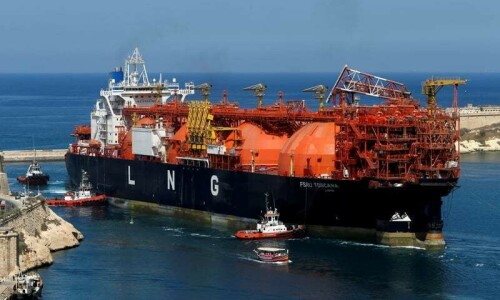
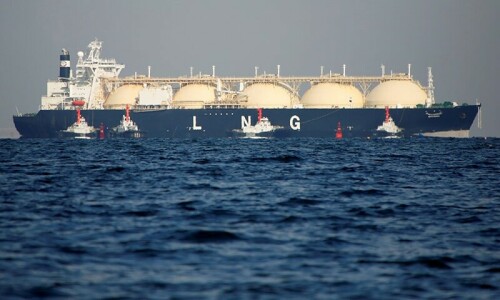
In a detailed policy advice, the Energy Planning and Resource Centre (EPRC) of the Planning Commission has also called for setting up a third floating LNG terminal, disconnecting gas supply to captive power plants of the industrial sector and using old gas fields to store imported LNG for peak consumption months.
Stressing that the current gas pricing regime did not reflect the LNG basket price to the domestic sector, the EPRC advised the government to “take policy decisions to truly reflect the LNG-delivered cost in the gas pricing mechanism” as the existing gas pricing was not cost reflective.
It said the supply of LNG through pipelines in areas where a gas distribution system is absent would be more affordable and accessible compared to the expensive and hazardous LPG.
“Cost-reflective pricing regime can be enforced by passing on cost-based LNG prices to the consumers” to reduce gas demand and subsidies.
Giving a price comparison between natural gas, LNG and LPG, the Planning Commission’s resource centre noted that the basket price of domestic gas stood at $5.02 per million British thermal units (mmBtu) against LNG’s $16.84 and LPG’s $22.06.
The comparison “clearly shows the high basket price of LPG as compared to its competitors. While natural gas is the cheapest source, LNG lies at a moderate rate as compared to highly expensive LPG”, it said.
“In ordinary market situations, LNG has the potential to replace LPG in the domestic sector,” it said, adding that the “comparative price analysis of LPG and LNG suggests that the basket price of LPG is higher than LNG which could create financial difficulties if its import is increased”.
Therefore, the supply of LNG through pipelines in areas and sectors where the distribution system is absent would be more affordable and accessible compared to the expensive LPG, it said, noting that the average annual LNG basket price in 2022 was cheaper than the LPG basket price.
The policy advice also highlighted large variations in the international LNG prices due to many factors and noted that the spot prices of the fuel went as high as $30.60 per mmBtu in the previous year.
The Planning Commission also suggested that the “consumer prices should be revised according to the estimated revenue requirements of the Sui distribution companies”.
The delay in the revision of gas prices has resulted in the accumulation of a large revenue shortfall or tariff differential.
“Hence to avoid the accumulation of tariff differential and sustainability of the gas sector, prices need to be revised as per its due timeline,” it said.
It said the current gas pricing regime in the country was not financially sustainable, as it had caused a deficit in the annual cost recovery, accumulation of gas circular debt, and burden on the public sector’s LNG-importing companies.
Therefore, the “natural gas prices require revision as per the market dynamics, including LNG
purchase price and cost of local gas production” as a substantial variance of $9.62 per mmBtu between the LNG basket price and the natural gas price had to be bridged by the government as subsidy.
It said that based on current and forecasted peak demand for LNG, the country’s available terminal capacity can facilitate LNG imports until 2025. Thereafter, an additional terminal with a minimum capacity of 600 million cubic feet per day (mmcfd) will be required to manage the anticipated import requirement of 1,900 mmcfd by 2030.
Moreover, to reduce the dependence on expensive LNG imports from spot markets, Pakistan should consider pipeline import of natural gas through neighbouring countries.
The proposed Tapi pipeline could supply 1,350 mmcfd of gas, while the Iran-Pakistan pipeline could supply 750 mmcfd.
However, Pakistan first needed to ensure contractual commitments of the parties involved in Tapi, such as ensuring per-unit transit fee and transit royalty payments of gas passing from Pakistan to India, the research centre said.
Published in Dawn, August 21st, 2023