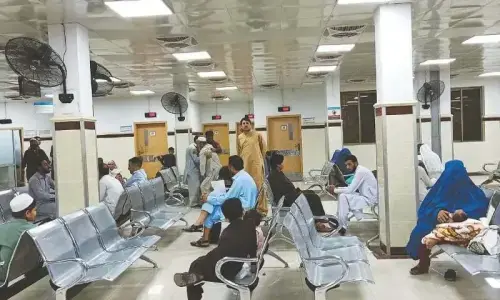
LAKKI MARWAT: The health department has recorded a surge in malaria cases here and said it along with partner organisations had stepped up efforts to contain the vector-borne disease.
A total of2,302malaria cases were reported in Lakki Marwat during last year’s first six months (Jan-June) but the tally surged to 8,611in the corresponding period this year, showed the statistics compiled by the health department.
According to the department, the “microscopy and rapid diagnostic centres” established at hospitals and health centres with the support of partner organisations screened 65,958 people for malaria between Jan and June last year, while the number totalled 67,241 in the corresponding period this year.
Those people had symptoms of the infectious disease like fever, shivering, body pain and sweating.
Officials said malaria incidence had increased in both urban and rural areas, so it had mobilised its resources to fight the disease effectively.
They blamed the growing cases on the downpour-induced flooding, incomplete treatment by patients, and people’s failure to take precautionary measures against the disease.
The officials also said poor personal hygiene, garbage dumps, poor sewerage, drainage and sanitation systems, uncovered tanks and ponds, and other mosquito breeding sites also spread malaria.
“Malaria incidence has increased in Lakki city, Wanda Shuja, Ahmadkhel, Esakkhel and Wanda Mir Alam, Abdulkhel, Shah Hasankhel, Darra Tang and other hamlets in the last several months,” entomologist Mohammad Jamil told Dawn.
He said those cases went up significantly in April, May and June due to a sudden change in weather, especially downpour-induced flash floods, which provided mosquitoes with breeding sites.
The expert said people in many rural areas were vulnerable to the infection due to insanitation and a lack of cleanliness, and sewage and wastewater management.
When contacted, focal person for the malaria control programme Aziz Khan said the malaria-hit areas were fumigated to kill mosquitoes and larvae, while the health department was striving to contain the disease through awareness walks and sessions.
The residents voiced concern over the rising malaria cases.
Dil Nawaz of Daulatkhel area said malaria was common in the village with many suspected patients approaching quacks for treatment due to a lack of awareness of free treatment at government health centres.
Habibur Rehman, who lives along the Gambila River, advocated fumigation to destroy mosquito-breeding grounds.
District health officerDr Abdugulsaid the health department with the support of partner organisations offered free malaria diagnosis and treatment at both government and private health centres across the district, so patients should avail themselves of it.
He said children and pregnant women should be the focus of anti-malaria efforts.
The DHO promised the provision of mosquito nets to people across the district.
Published in Dawn, July 28th, 2023