Scientists spot ‘two-faced’ white dwarf star


 0
0
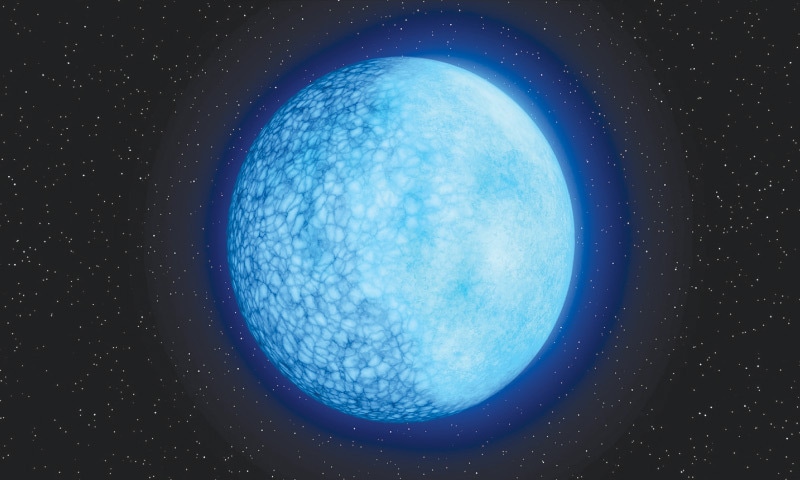

WASHINGTON: Some people are two-faced, figuratively speaking of course. The ancient Roman god Janus was two-faced, literally — with one looking forward and another backward, representing transitions and duality. But a two-faced star? Yes, indeed.
Scientists have observed a white dwarf star — a hot stellar remnant that is among the densest objects in the cosmos — that they have nicknamed Janus owing to the fact it has the peculiar distinction of being composed of hydrogen on one side and helium on the other.
“Janus is the Roman god with two faces, so we thought it was very appropriate. Moreover, Janus is the god of transition, and the white dwarf might be currently transitioning from having an atmosphere made of hydrogen to one made of helium,” said Ilaria Caiazzo, a Caltech postdoctoral fellow in astrophysics and lead author of the study published this week in the journal Nature.
The star is located in our Milky Way galaxy about 1,300 light years from Earth in the direction of the Cygnus constellation. A light year is the distance light travels in a year, 5.9 trillion miles (9.5 trillion km).
Janus is fairly massive for a white dwarf, with a mass 20 per cent larger than that of our sun compressed into an object with a diameter half that of Earth. It rotates on its axis every 15 minutes — very fast considering these stars usually rotate every few hours to a few days.
“White dwarfs form at the very end of a star’s life. About 97pc of all stars are destined to become white dwarfs when they die,” Caiazzo said.
“Our sun, for example, is currently burning hydrogen into helium in its core. When the hydrogen in the core is depleted, the sun will start burning helium into carbon and oxygen. When the helium also is gone from the centre, the sun will eject its outer layers into space in an event called a planetary nebula and the core will slowly contract and become a white dwarf,” Caiazzo added.
Published in Dawn, July 22nd, 2023