0
0


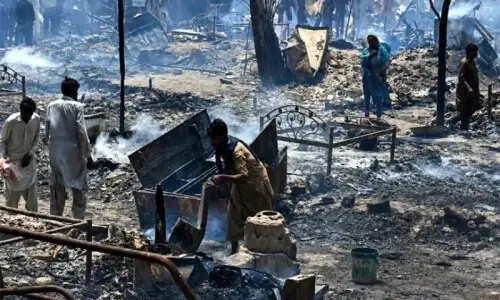
SINCE it was budget season, news items about the government and its administrative units’ plans for the next year kept trickling in. On July 3, 1973, for example, it was announced that the Karachi Municipal Corporation (KMC) would construct three new fire stations during 1973-74 at Drigh Colony, Federal B Area and Clifton. The site for the Drigh Colony station had already been selected.
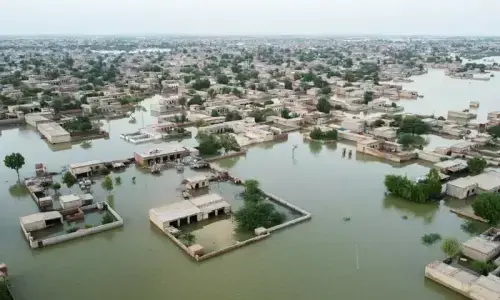
It seemed that fire extinguishing teams were not needed at that point in time because on July 6, one inch of rain was recorded in Karachi in the last 24 hours. Hundreds suffered when auto-rickshaws and taxi drivers refused to carry them after the downpour began at noon. Weather experts predicted more rains. The reason for the sudden change in the sultry climate was the low pressure that had developed over the north Arabian Sea off the Gujarat Katch coast, causing incursion of monsoon in Sindh. In order to cope with an emergency, three centres were set up in the Landhi-Korangi Municipal Committee area. By that time, the KMC squads, however, were not seen in action.
The next day, Sindh Chief Minister Mumtaz Ali Bhutto visited the rain-affected neighbourhoods to look at the relief operations carried out by the civic bodies. His tour lasted for two and a half hours — from 2:30pm to 5pm — in which he met with people and assured the government’s help for them. He drove through Saddar, M A Jinnah Road via Empress Market, Soldier Bazaar and Lyari.
On July 8, a special meeting of the Sindh cabinet reviewed the progress of relief and rehabilitation measures taken by various agencies. It was felt that citizens should be immediately provided with proper shelter, adequate food and necessary medical aid on an urgent basis. The chief minister, who presided over the meeting, asked his cabinet ministers to go to the rain-hit areas in order to make relief measures more effective.
The city authorities were in the news for another reason on July 4. Ahmad Altaf, General Secretary of the Urdu Qaumi Council, in a statement criticised the Karachi administration for not allowing a meeting at Katrak Hall on July 7 in memory of the ‘Shuhada-i-Urdu’ of 1972. He said the council had decided to observe the anniversary in a quiet manner at the shuhadas’ graves. Mahmudul Haq Usmani, Rais Amrohvi, Syed Muhammad Taqi and Alauddin Abbasi were to place wreath at the graves and offer fateha.
The other issue faced by Karachiites that week was of an entirely different nature. There was shortage of vanaspati ghee in the Sindh capital. On July 6, it was reported that there was a serious scarcity of ghee. Vanaspati in five-lbs ‘tins’ was available only to select customers while 10-lbs tins were either kept under the counter or being sold on the black market. When contacted by the media, a prominent manufacturer said the supply from their end was normal but the retailers had converted it into ‘un-tinned’ vanaspati to earn larger profits. A leading brand of ghee in 10-lbs tins was being sold at Rs26 as against the fixed price of Rs24.50.
Published in Dawn, July 3rd, 2023