Himalayan glaciers melting 65pc faster than last decade: study



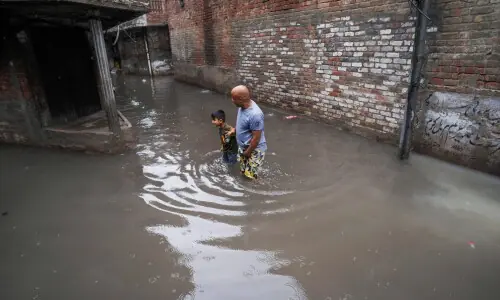
KATHMANDU: Himalayan glaciers providing critical water to nearly two billion people are melting faster than ever before due to climate change, exposing communities to unpredictable and costly disasters, scientists warned on Tuesday.
The glaciers disappeared 65 per cent faster from 2011 to 2020 compared with the previous decade, according to a report by the International Centre for Integrated Mountain Development (ICIMOD).
“As it gets warmer, ice will melt, that was expected, but what is unexpected and very worrying is the speed,” lead author Philippus Wester said. “This is going much faster than we thought.”
Glaciers in the Hindu Kush Himalaya (HKH) region are a crucial water source for around 240 million people in the mountainous regions, as well as for another 1.65 billion people in the river valleys below, the report said.
World 1.2°C warmer than mid-1800s
Based on current emissions trajectories, the glaciers could lose up to 80 per cent of their current volume by the end of the century, said the Nepal-based ICIMOD, an inter-governmental organisation that also includes member countries Afghanistan, Bangladesh, Bhutan, China, India, Myanmar and Pakistan.
“With two billion people in Asia reliant on the water that glaciers and snow here hold, the consequences of losing this cryosphere (a frozen zone) are too vast to contemplate,” said ICIMOD’s deputy chief Izabella Koziell.
‘Too vast to contemplate’
Even if global warming is limited to the 1.5 to 2.0 degrees Celsius from pre-industrial levels agreed to in the Paris climate treaty, the glaciers are expected to lose a third to a half of their volume by 2100, the peer-reviewed report said. “It underscores the need for urgent climate action.”
The world has warmed an average of nearly 1.2C since the mid-1800s, unleashing a cascade of extreme weather, including more intense heatwaves, more severe droughts and storms made more ferocious by rising seas.
Hardest hit are the most vulnerable people and the world’s poorest countries, which have done little to contribute to the fossil fuel emissions that drive up temperatures, said Amina Maharjan, a livelihoods and migration specialist.
“Most of the adaptation is communities and households reacting (to climate events). It is inadequate to meet the challenges posed by climate change,” Maharjan said. “What is going to be very critical moving forward is anticipating change,” she said.
Published in Dawn, June 21st, 2023