THE prevailing political and economic instability in the country offers perfect conditions for terrorist networks to grow and strengthen themselves. As persisting political turmoil dominates the mainstream discourse, terrorist groups are busy restructuring their networks.
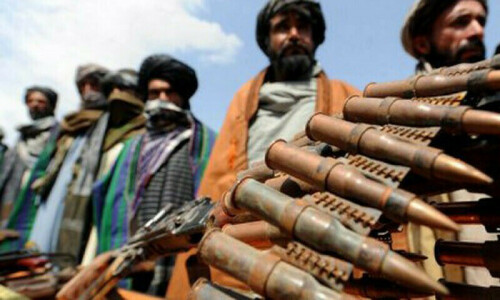
Last week, the banned Tehreek-i-Taliban Pakistan (TTP) announced new formations, indicating that the group has been gaining strength. Now, it is spreading its wings and establishing new chapters in the country’s religiously and ethnically vulnerable regions. It is a strategy of the terrorist group to hit the softest parts of the country to make the challenges of security and national cohesion more complex.
The TTP has announced three new ‘administrative units’ for the Baloch-dominated Kalat and Makran region and south and north Punjab. According to the ‘Khorasan Diary’, a web portal that monitors militants’ activities in Pakistan, the number of TTP administrative units has reached 12 in the country, out of which seven are in Khyber Pakhtunkhwa, one in Gilgit-Baltistan, and two each in Balochistan and Punjab.
Interestingly, the TTP announced these formations after reports emerged of group infighting. It has been said that frustration has been brewing in their ranks because of the pressure exerted by the Afghan Taliban, who want to pacify Pakistan regarding their role in supporting the TTP. However, insufficient evidence is available that the Afghan Taliban regime has tried to put pressure on the TTP. In fact, according to some other accounts, the Taliban’s support for the TTP is not only intact but is also on the rise.
The TTP is spreading its wings and establishing new chapters in vulnerable regions.
A major source of differences in TTP ranks is linked with the distribution of offices and resources. According to media reports, TTP Swat’s Mufti Barjan was injured in a clash in January last year, whereas Muslim Yar was killed. In another internal clash in May last year, some key commanders of the TTP Swat chapter were killed, including Usman, Bilal, Jannat Gul and Hazratullah. In the same month last year, Tehreek-i-Taliban Bajaur’s ameer Gohar was killed, and Zubar alias Kala was killed in June 2022. Similarly, militant commanders Badshah Khan and Rosham, along with four others, were killed in September last year. In October 2022, TTP Balochistan’s commander Bismillah alias Pehalwan was killed. Such incidents of infighting have been taking place recently also, including in Pakistan and Afghanistan. However, it is not clear if the Afghan Taliban have played any role in resolving the TTP commanders’ internal disputes and unifying them. Al Qaeda had done this job several times in the past.
Meanwhile, the TTP’s efforts of absorbing new groups continues. The banned group claimed last month through a statement that another group of Pakistani militants from North Waziristan and led by commander Yasir Dawar had joined the group by pledging allegiance to the TTP chief Noor Wali Mehsud. At least four new groups reportedly announced their merger with the TTP in March 2023. This latest merger of the Yasir Dawar group takes the count of such mergers with the TTP since July 2020 to 28.
The expansion of the TTP network has multiple implications. The southern area of Punjab was already facing militancy challenges. Extremist groups of different shades have been operating there. During the recent operation in the katcha area of Punjab, security forces found evidence of the presence of TTP militants there.
However, it was the northern Punjab formation that surprised but since its inception, north Punjab has always remained a priority for the TTP. The location of the federal capital is one reason for this, but Lal Masjid, too, played a significant role in the formation of the TTP, and military operations against the militants in the mosque had triggered a wave of suicide attacks in the federal capital and surrounding districts. The mosque still inspires the TTP and Al Qaeda associates, and the name of the north Punjab chapter also contains the alias of ‘Ghazi’’ to show its affiliation with Lal Masjid. Rawalpindi remained affected by terrorist attacks even during relatively peaceful times from 2017 to 2022. Many TTP factions, including the Bali and Haji groups, remained focused on the outskirts of Islamabad. The reason was Lal Masjid; Abdul Rasheed Ghazi was killed during the military operation there. He has become an iconic figure for the TTP and like-minded groups. Ghazi was buried in south Punjab.
A new TTP formation in Balochistan is a significant development as the group’s growing influence in the province has remained under the radar for the last few months. The TTP footprint in Baloch regions was traced when a local Baloch jihadist group, led by Mazar Baloch from Makran, Balochistan, joined the TTP. Later, two other groups from Kalat and Quetta joined the TTP, led by Akram Baloch and Asim Baloch. Though it is unclear how many members or militants each of these groups has, it should still be a worrisome development for the security forces and the government. It indicates that the group has been consistently adding to its strength, which will undoubtedly enhance its operational capabilities in the areas where these newly merged groups are based.
The security forces are conducting successful operations against the TTP in and out of Quetta and the Pakhtun belt. However, expanding the group in areas already affected by the Baloch insurgency will make their task more complex. It is the TTP’s declared policy to encroach on Baloch regions as the group believes that the area is ripe for new recruitments, mainly from the youth of religious institutions, who have political and ideological reasons for not joining the Baloch insurgents. Though reports often emerge about a probable nexus between the Baloch insurgents and the TTP, more evidence is needed to support this observation.
These emerging trends of terrorism will only add to Pakistan’s persistent security challenge in terms of Taliban militancy in KP and the erstwhile tribal areas and the Baloch nationalist insurgency in Balochistan. Extended over a longer period, such an environment of insecurity, militancy and violence can also pose serious threats to political and economic stability.
The writer is a security analyst.
Published in Dawn, June 18th, 2023