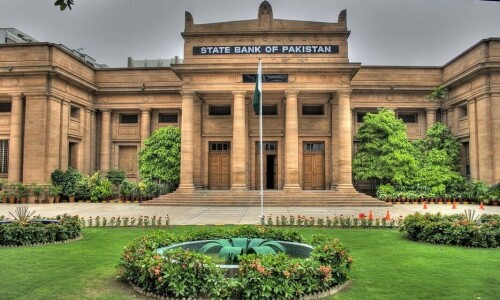
The State Bank of Pakistan (SBP) has decided to keep the policy rate unchanged at 21 per cent for the next two months, according to a press release issued on Monday.
The announcement came after a meeting of the bank’s Monetary Policy Committee (MPC).
“The MPC assessed inflation is more likely to have peaked in May 2023. Weak domestic demand; ease in inflation expectations of consumers and businesses; downward trend in global commodity prices; and high base effect, are the major determining factors behind this assessment,” the central bank’s statement said.
It stated that the MPC expected the domestic demand to “remain subdued amid tight stance, domestic uncertainty and continuing stress on external account”.
“In this backdrop, and given the declining m/m trend, the MPC views inflation to have peaked at 38pc in May 2023, and barring any unforeseen developments, expects it to start falling from June onwards,” it stated.
The committee noted in the press release that multiple important developments had taken place since the last meeting.
“First, the provisional national accounts estimates show real GDP (gross domestic product) growth to have decelerated considerably during FY23.
“Second, the current account balance recorded back-to-back surpluses in March and April 2023, which reduced some pressures on foreign exchange reserves,” it said.
Thirdly, the press release highlighted that the government had unveiled the budget for FY24 on June 9 which “envisages a slightly contractionary fiscal stance against the revised estimates for FY23”.
Fourth, the global commodity prices and financial conditions have eased recently and are expected to persist in near term, it added.
The MPC also took stock of the cumulative impact of the substantial monetary tightening undertaken so far, which “is still unfolding”.
“On balance, the MPC views the current monetary policy stance, with positive real interest rates on forward looking basis, as appropriate to anchor inflation expectations and to bring down inflation towards the medium term target — barring any unexpected domestic and external shocks.
“However, the MPC emphasised that this outlook is also contingent on effectively addressing the prevailing domestic uncertainty and external vulnerabilities,” the press release added.
The committee noted that the “major drag” in the real GDP — which grew by 0.3pc in FY23 from the revised FY22 growth of 6.1pc — came from a “significant contraction in value addition of industry due to several adverse domestic and external factors”, while services sector grew at the “slowest pace” since the Covid-impacted FY20.
“The agriculture sector growth was lower than last year but better than post-flood expectations, as bumper sugarcane and wheat crops and robust growth in the livestock sector largely offset the flood-related damages to cotton and rice crops.”
The MPC further said that the slowdown in economic activity was in line with the trends in high-frequency indicators, especially double-digit declines in volumes of auto, POL and domestic cement sales, and contraction in large scale manufacturing during the course of this fiscal year.
These trends, it pointed out, were expected to continue in the near term because of accumulated impact of tight policies.
“On the other hand, in the absence of any unfavorable turn in weather conditions, the agriculture sector is expected to post an improved performance relative to the outgoing fiscal year,” the committee said.
Moreover, it noted that that the narrowing of the current account deficit had contained the pressure son the foreign exchange reserves and the interbank exchange rate.
“However, debt repayments amid lower fresh disbursements and weak investment inflows continue to exert pressure on the FX reserves.”
The committee was of the opinion that the target for the overall fiscal deficit was not significantly different from the revised estimate for FY23, “strictly adhering to it is imperative to contain inflationary and external account pressures”.
“The MPC expects that reduced demand-side pressures and ease in inflation expectations, along with moderating global commodity prices and high base effect, would help bring inflation down from June 2023 onwards. In this context, the MPC views that maintaining the current policy stance is necessary to bring inflation down to the medium-term target range of 5-7pc by the end of FY25,” the press release added.
Meanwhile, analysts said the decision was largely expected as the country’s broader economic challenges, including repayment of its debt, continued to loom.
“This was expected as inflationary pressure are easing … SBP believes real rates are positive on forward looking basis thus justifying this decision,” said Sohail Mohammed, chief executive of brokers Topline Securities.
“I think that biggest issue is how will Pakistan repay its upcoming 22 billion dollar debt repayment,” he added.
Additional input from Reuters